16 Known Divine Forms of Lord Murugan
Each form carries its own name rooted in Puranic or Sangam literature, its own iconography, its own temple, and a specific grace it bestows
A
Astrogya TeamMurugan
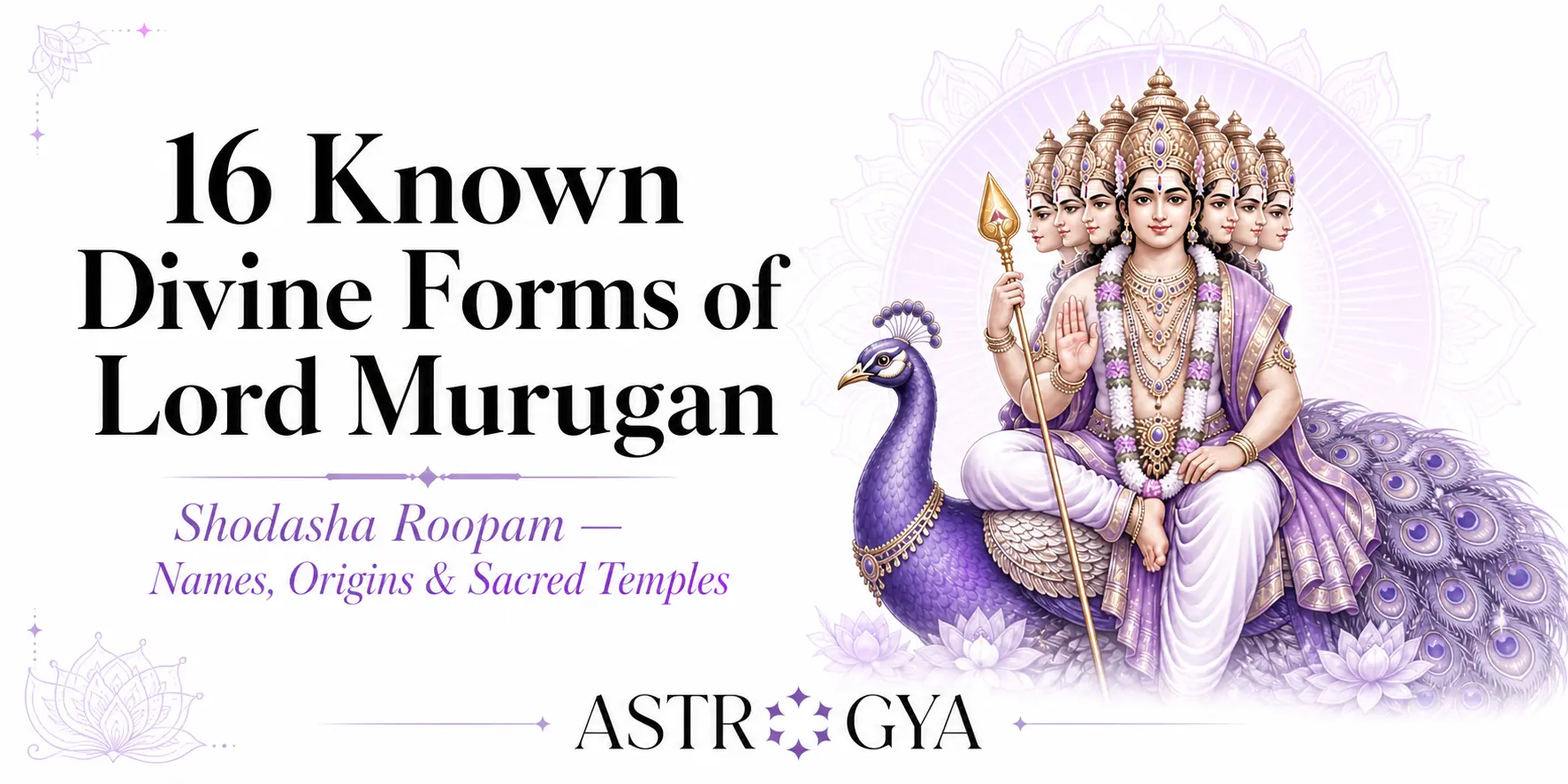
Lord Murugan born of Shiva's cosmic fire, nurtured in the sacred reeds of Saravana Poigai, commander of the celestial armies reveals himself in sixteen distinct divine forms known as Shodasha Roopam. Shodasha means sixteen in Sanskrit; Roopam means form or manifestation.
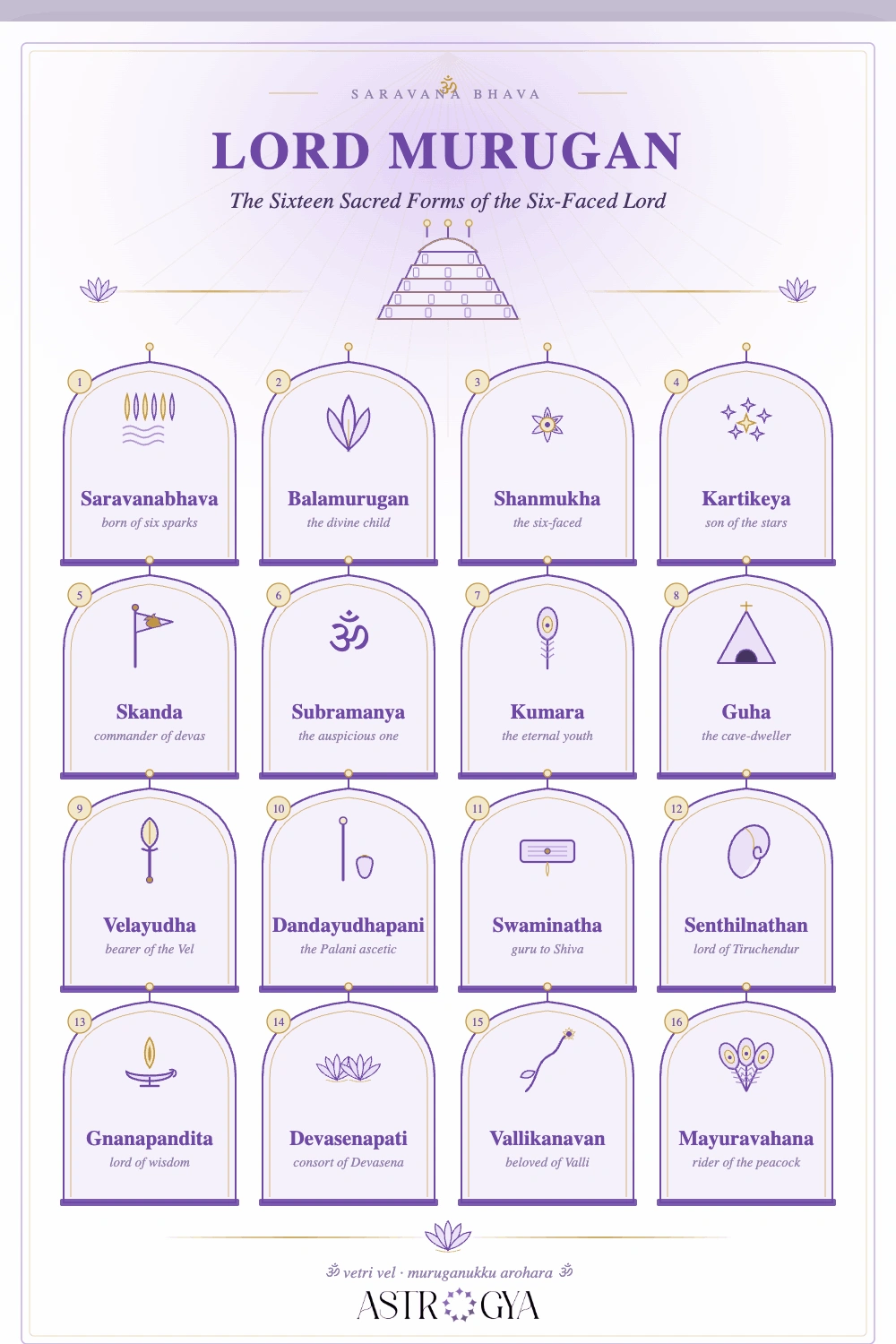
Each form carries its own name rooted in Puranic or Sangam literature, its own iconography, its own temple, and a specific grace it bestows. The same Lord who teaches the meaning of Om to Shiva also sits as a tribal ascetic on a hillside with nothing but a staff. Understanding these forms transforms how a devotee worships you do not approach Dandayudhapani for the same reason you approach Devasenapati.
The six sacred Arupadai Veedu Thirupparankundram, Thiruchendur, Palani, Swamimalai, Thiruthani, and Pazhamudircholai anchor several of these forms across Tamil Nadu.
All 16 Forms at a Glance
# | Form | Meaning | Primary Temple | Key Blessing |
|---|---|---|---|---|
1 | Bala Murugan | Divine Child | Poombarai, Kodaikanal, TN | Children's protection |
2 | Shanmukha / Arumugan | Six-Faced Lord | Shrungagiri, Bengaluru, KA | All-directional blessings |
3 | Guhan | Indwelling Lord | Sikkal Singaravelan, TN | Inner peace, meditation |
4 | Shaktivel | Bearer of Shakti Spear | Palani, Dindigul, TN | Obstacle removal |
5 | Murugan | Beautiful / Youthful | Pazhamudircholai, Madurai, TN | Devotional grace |
6 | Tharakari | Slayer of Taraka | Thiruchendur, Thoothukudi, TN | Victory over inner demons |
7 | Valli Devasena Sametha | Lord with Both Consorts | Pazhamudircholai, Madurai, TN | Marital and family harmony |
8 | Dandayudhapani | The Ascetic | Palani, Dindigul, TN | Detachment, moksha |
9 | Swaminatha | Divine Teacher/Guru | Swamimalai, Kumbakonam, TN | Wisdom, academic success |
10 | Saravana Bhava | Born of Reed-Lake | Thiruparankundram, Madurai, TN | Purification, fresh starts |
11 | Vadi Velan | The Sharp-Speared One | Thiruchendur, Thoothukudi, TN | Cutting through illusion |
12 | Devasenapati | Divine Commander | Thirupparankundram, Madurai, TN | Leadership, authority |
13 | Subrahmanya | Vedic Supreme Name | Kukke Subramanya, Karnataka | Sarpa Dosha relief |
14 | Skanda | One Who Leapt Forth | Kartik Swami, Uttarakhand | Swift divine intervention |
15 | Kartikeya | Son of the Krittikas | Kartik Swami, Uttarakhand | Celestial protection |
16 | Seyon (Ceyon) | The Red One | Ancient Tamil hill shrines | Primal grace, fierce protection |
Explore Murugan's astrological significance his connection to Mars, Krittika Nakshatra, and spiritual timing at astrogya.com/murugan →
1. Bala Murugan (Bāla Murugaṉ)
Field | Details |
|---|---|
Sanskrit/Tamil Name | Bāla Murugaṉ |
Meaning | Bāla = child; "The Divine Child Murugan" |
Origin / Source Text | Ancient Tamil Sangam tradition; Kurinji (hill country) worship of the child deity |
Divine Attributes | Innocent, playful, pure; Murugan before wars or weapons only divine joy |
Blessing Invoked | Protection for children, safe birth, parental peace of mind |
Primary Temple | Kuzhanthai Velappar Temple (Poombarai Murugan Temple), Poombarai, Kodaikanal, Tamil Nadu |
Secondary Temple | Siruvapuri Bala Murugan Temple, Siruvapuri, Tamil Nadu |
Best Time to Visit | Panguni Uthiram, Skanda Sashti |
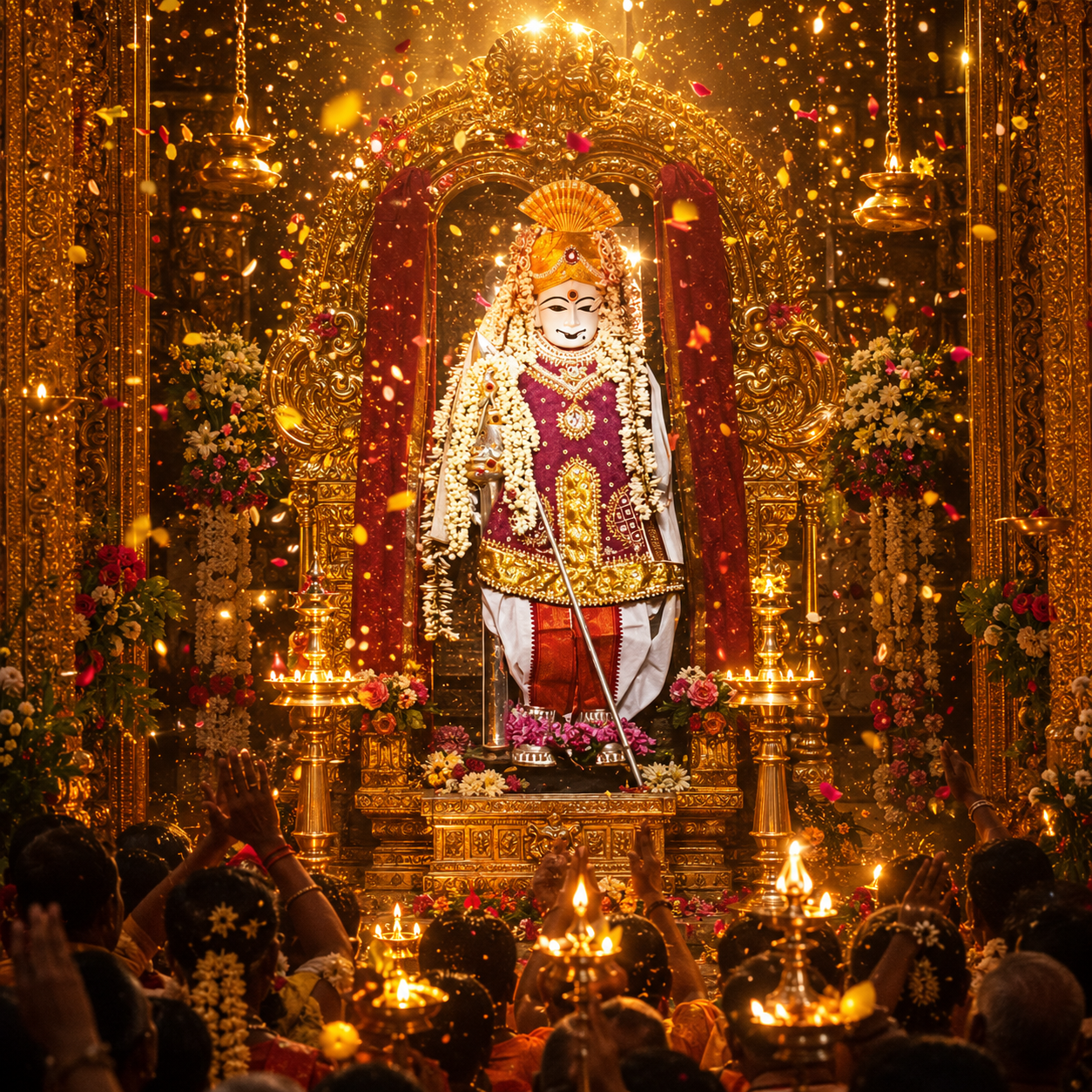
Sangam poets celebrated a child deity of the Kurinji hill country long before stone temples rose in Tamil Nadu. The Poombarai temple, perched at 1,920 metres in the Palani Hills and approximately 3,000 years old, was originally built by the Chera dynasty. The annual Ther Thiruvizha (chariot festival) here connects modern devotion to a tradition older than most known temples in the region.
2. Shanmukha / Arumugan (Ṣaṇmukha / Āṟumukaṉ)
Field | Details |
|---|---|
Sanskrit/Tamil Name | Ṣaṇmukha (Sanskrit) / Āṟumukam (Tamil) |
Meaning | Shan = six, mukha = face; "The Six-Faced Lord" |
Origin / Source Text | Skanda Purana, Mahabharata; six sparks of Shiva merged by Parvati into one divine form |
Divine Attributes | Six faces: jñāna, bhakti, shakti, yashas, dhairya, vairāgya; twelve hands |
Blessing Invoked | All-directional protection, omniscient guidance, complete spiritual development |
Primary Temple | Shrungagiri Sri Shanmukha Swami Temple, Bengaluru, Karnataka |
Secondary Temple | Thirupparankundram Subramaniya Swamy Temple, Madurai, Tamil Nadu |
Best Time to Visit | Skanda Sashti, Thaipusam |
Each face corresponds to one of the six Krittika star-mothers who nursed the divine infant which is also why six faces became the deity's defining iconography. Arumugan is the Tamil translation of Shanmukha: same theology, different linguistic heritage, both equally authoritative.
3. Guhan (Guhā / Guhaṉ)
Field | Details |
|---|---|
Sanskrit/Tamil Name | Guhā (Sanskrit) / Guhaṉ (Tamil) |
Meaning | Guha = cave; "The one dwelling in the cave of every heart" |
Origin / Source Text | Ashtottara Shatanamavali (108 names); Skanda Purana; Thiruppugazh hymns |
Divine Attributes | The inner guide (antaryāmin); intimate, accessible, requires no external ritual |
Blessing Invoked | Self-realization, meditation depth, relief from inner loneliness |
Primary Temple | Sikkal Singaravelan Temple, Sikkal, Nagapattinam district, Tamil Nadu |
Secondary Temple | Batu Caves Temple, Gombak, Selangor, Malaysia |
Best Time to Visit | Aadi Krithigai, Kanda Sashti |
Ancient texts use guha metaphorically for the innermost chamber of consciousness where the divine permanently resides making this the most intimate of all sixteen forms. Tamil devotional hymns address Guhan as "the friend within who never leaves." The cave structure of Batu Caves in Malaysia is the correct architectural symbol for this form: you enter the hill the way a devotee turns inward.
4. Shaktivel (Śakti-Vēl)
Field | Details |
|---|---|
Sanskrit/Tamil Name | Śakti-Vēl |
Meaning | Shakti = Parvati's cosmic energy; Vel = spear; "Bearer of the Goddess-empowered Spear" |
Origin / Source Text | Skanda Purana; Kanda Puranam; Parvati's gift of the empowered Vel before the battle with Surapadman |
Divine Attributes | Broad head = expansive knowledge; long shaft = discipline; sharp tip = cuts through illusion |
Blessing Invoked | Obstacle removal, inner strength, victory over enemies |
Primary Temple | Arulmigu Dhandayuthapani Swamy Temple, Palani, Dindigul district, Tamil Nadu |
Secondary Temple | Thiruchendur Murugan Temple, Thoothukudi, Tamil Nadu |
Best Time to Visit | Thaipusam (Kavadi procession), Skanda Sashti |
The Vel is not merely a weapon it carries Parvati's full energy within it, which is why it is worshipped independently in rural Tamil Nadu temples. Thaipusam's Kavadi ritual is the most public expression of this form's devotional culture: the devotee carries the vel-shaped structure as penance and declaration simultaneously.
5. Murugan (Murugaṉ)
Field | Details |
|---|---|
Sanskrit/Tamil Name | Murugaṉ purely Tamil, no Sanskrit root |
Meaning | Muru = youth, beauty, fragrance; "The Beautiful and Fragrant Youth" |
Origin / Source Text | Tamil Sangam literature, 3rd century BCE; Akam and Puram poetry |
Divine Attributes | Eternal youth; deity of the Kurinji (hill) landscape; radiant, intimate |
Blessing Invoked | Devotional intimacy, grace, beauty, cultural protection |
Primary Temple | Pazhamudircholai Murugan Temple (Solaimalai), Madurai district, Tamil Nadu |
Secondary Temple | Marudhamalai Murugan Temple, Coimbatore, Tamil Nadu |
Best Time to Visit | Panguni Uthiram, Vaikasi Visakam |
Murugan is the only name among all sixteen that is purely Tamil no Sanskrit root, no Puranic invention. Sangam literature describes him as the Red God seated on a blue peacock, eternally young, considered the presiding deity of the present age (Kaliyuga Vardhan). Pazhamudircholai, the sixth Arupadai Veedu set amid lush hills near Madurai, is where this pastoral, intimate form feels most at home.
6. Tharakari (Tārakāri)
Field | Details |
|---|---|
Sanskrit/Tamil Name | Tārakāri |
Meaning | Tāraka = demon Tarakasura; ari = slayer; "The Slayer of Taraka" |
Origin / Source Text | Skanda Purana; Tarakasura's boon only a son of Shiva could destroy him |
Divine Attributes | Cosmic warrior; appointed commander of celestial armies at six days old |
Blessing Invoked | Victory over ego and internal demons fear, pride, chronic doubt |
Primary Temple | Arulmigu Subramaniya Swamy Temple (Thiruchendur), Thoothukudi, Tamil Nadu |
Secondary Temple | Kartik Swami Temple, Kronch Parvat, Rudraprayag, Uttarakhand |
Best Time to Visit | Skanda Sashti Surasamharam on the sixth day |
Tarakasura's boon that only an unborn son of Shiva could kill him made Murugan's very birth a cosmic assignment. He accomplished this mission at six days old, leading the entire celestial army into the final battle at Thiruchendur. The Surasamharam festival here annually re-enacts that decisive moment.
7. Valli Devasena Sametha (Vaḷḷi Deivayanai Sametha)
Field | Details |
|---|---|
Sanskrit/Tamil Name | Vaḷḷi Deivayanai Sametha Murugaṉ |
Meaning | Murugan with Valli (Iccha Shakti) and Deivanai (Kriya Shakti) together |
Origin / Source Text | Kanda Puranam (Tamil); Skanda Purana |
Divine Attributes | Complete cosmic trinity: Jnana Shakti + Iccha Shakti + Kriya Shakti |
Blessing Invoked | Marital harmony, family prosperity, balance of love and duty |
Primary Temple | Pazhamudircholai Murugan Temple, Solaimalai Hills, Madurai district, Tamil Nadu |
Secondary Temple | Tiruttani Murugan Temple, Tiruvallur district, Tamil Nadu |
Best Time to Visit | Panguni Uthiram, Vaikasi Visakam |
Pazhamudircholai is the only Arupadai Veedu where Murugan stands simultaneously with both consorts making it the singular sannidhi for devotees seeking the complete-family blessing. Pazhamudircholai means "the grove where fruits ripen" abundance in every dimension is the theological promise of this form.
8. Dandayudhapani (Daṇḍāyudhapāṇi)
Field | Details |
|---|---|
Sanskrit/Tamil Name | Daṇḍāyudhapāṇi |
Meaning | Daṇḍa = staff; āyudha = weapon; pāṇi = hand; "He who holds only the staff" |
Origin / Source Text | Legend of Murugan's renunciation after Ganesha won the divine fruit; retreat to Palani Hills |
Divine Attributes | Ascetic, unadorned no crown, no weapons; pure vairāgya (detachment) |
Blessing Invoked | Liberation from material attachment, healing, spiritual discipline, moksha |
Primary Temple | Arulmigu Dhandayuthapani Swamy Temple, Palani, Dindigul district, Tamil Nadu |
Secondary Temple | Marudhamalai Murugan Temple, Coimbatore, Tamil Nadu |
Best Time to Visit | Thaipusam, Panguni Uthiram, Thai Poosam |
After Ganesha won the divine fruit of all wisdom, Murugan left in silence and installed himself as an ascetic on the Palani Hills his only statement being: "I am the fruit. I need no fruit to prove it." The Palani idol is pharmacologically unique: Sage Bogar crafted it from navapāshanam (nine medicinal herbs compounded into one solid form), and the abhishekam water is believed to carry genuine healing properties.
Saturn or Ketu transits creating prolonged detachment in your chart? The Dandayudhapani form is the recommended sannidhi for this period. See your transit report on Astrogya
9. Swaminatha (Svāmināthaṉ)
Field | Details |
|---|---|
Sanskrit/Tamil Name | Svāmināthaṉ |
Meaning | Svāmi = Master; nātha = teacher; "The Lord who taught his own father" |
Origin / Source Text | Swamimalai temple legend; Murugan teaches Shiva the meaning of Pranava Mantra (Om) |
Divine Attributes | Divine Guru; revealer of Om; spiritual authority beyond age or lineage |
Blessing Invoked | Academic success, wisdom, teaching ability, spiritual knowledge |
Primary Temple | Swaminathaswamy Temple, Swamimalai, near Kumbakonam, Thanjavur district, Tamil Nadu |
Secondary Temple | Thiruporur Murugan Temple, Kancheepuram district, Tamil Nadu |
Best Time to Visit | Vaikasi Visakam, Skanda Sashti, Thursdays |
When Shiva asked for the meaning of Om, Murugan led him to the top of the Swamimalai hill and whispered the secret into his father's ear child teaching the Absolute the nature of the Absolute. The sixty steps to the sanctum represent the sixty years of the Tamil calendar cycle, and every step is a meditation on the guru who stands outside time.
10. Saravana Bhava (Sāravanabava)
Field | Details |
|---|---|
Sanskrit/Tamil Name | Sāravanabava |
Meaning | Sara = reed; vana = forest; bhava = born; "He who was born in the sacred reed-lake" |
Origin / Source Text | Skanda Purana; six sparks of Shiva carried to Saravana Poigai by Agni and Vayu |
Divine Attributes | Primordial purity; divine origin through fire, water, earth, and air; new beginnings |
Blessing Invoked | Spiritual purification, fresh starts, protection from birth-time doshas |
Primary Temple | Thiruparankundram Subramaniya Swamy Temple, Madurai, Tamil Nadu |
Secondary Temple | Saravana Poigai sacred site, near Palani Hills, Tamil Nadu |
Best Time to Visit | Skanda Sashti, Thaipusam |
Om Saravana Bhava is among the most widely chanted Murugan mantras three words that compress the entire birth narrative into a single invocation. From a Vedic astrology standpoint, this is the form most connected to prenatal karma: the six Krittikas who nursed the six infants correspond directly to Krittika Nakshatra, making this form particularly relevant for devotees with birth-chart afflictions.
Explore the significance of Krittika Nakshatra and Saravana Bhava in your Vedic birth chart at Astrogya
11. Vadi Velan (Vāḍi Vēlaṉ)
Field | Details |
|---|---|
Sanskrit/Tamil Name | Vāḍi Vēlaṉ |
Meaning | Vāḍi = sharp, penetrating; Vēl = divine spear; "He whose Vel is eternally sharp" |
Origin / Source Text | Tamil classical temple tradition; active, battle-ready warrior aspect |
Divine Attributes | Divine energy in motion; the Vel as conscious, unstoppable penetrating force |
Blessing Invoked | Cutting through illusion, overcoming enemies, protection in crisis |
Primary Temple | Arulmigu Subramaniya Swamy Temple (Thiruchendur), Thoothukudi, Tamil Nadu |
Secondary Temple | Sikkal Singaravelan Temple, Nagapattinam, Tamil Nadu |
Best Time to Visit | Skanda Sashti, Kanda Shashti |
Ancient Tamil texts describe the Vel as possessing its own divine consciousness it is both weapon and deity, both instrument and intention. Thiruchendur, the only Arupadai Veedu located on a seashore, is where devotees take a ritual ocean bath before entering the sanctum and where the Surasamharam festival re-enacts Murugan splitting Surapadman with a single Vel strike.
12. Devasenapati (Dēvasenāpati)
Field | Details |
|---|---|
Sanskrit/Tamil Name | Dēvasenāpati |
Meaning | Deva = god; senā = army; pati = lord; "Commander-in-Chief of the celestial armies" |
Origin / Source Text | Skanda Purana, Mahabharata; divine appointment at six days old |
Divine Attributes | Divine general; fearlessness, strategic authority; bearer of the divine flag |
Blessing Invoked | Career leadership, authority, courage in competitive situations |
Primary Temple | Thirupparankundram Subramaniya Swamy Temple, Madurai, Tamil Nadu |
Secondary Temple | Tiruttani Murugan Temple, Tiruvallur district, Tamil Nadu |
Best Time to Visit | Skanda Sashti (Surasamharam), Vaikasi Visakam |
At six days old, Murugan was appointed Commander-in-Chief of all celestial armies the most precocious military commission in Hindu mythology, requiring no experience, only an inherent authority. Thirupparankundram, the first Arupadai Veedu, is a Pandyan-era rock-cut cave temple where Murugan, after defeating Surapadman, married Deivanai (Devasena), daughter of Indra.
Read Kandar Alankaram
13. Subrahmanya (Subrahmaṇya)
Field | Details |
|---|---|
Sanskrit/Tamil Name | Subrahmaṇya |
Meaning | Su = auspicious; brahmaṇya = master of Brahman (spiritual wisdom) |
Origin / Source Text | Yajur Veda, Sama Veda, Atharva Veda, Chandogya Upanishad, Ramayana, Mahabharata |
Divine Attributes | Pure wisdom; upholder of Dharma; protector of serpent races (nāgas) |
Blessing Invoked | Removal of Sarpa Dosha, spiritual wisdom, family protection |
Primary Temple | Kukke Subramanya Temple, Western Ghats, Dakshina Kannada, Karnataka |
Secondary Temple | Thiruparankundram Subramaniya Swamy Temple, Madurai, Tamil Nadu |
Best Time to Visit | Subramanya Shashti, Ashlesha Nakshatra days |
Subrahmanya is the oldest attested name appearing in Vedic texts centuries before Tamil Sangam literature, making it the bridge between South Indian devotion and pan-Indian Vedic tradition. At Kukke Subramanya, divine serpents including Vasuki sought refuge from Garuda under Lord Subramanya's protection which is why the rituals of sarpa samskara and ashlesha bali performed here are specifically prescribed for Sarpa Dosha and Kala Sarpa Dosha afflictions in Vedic horoscopes.
14. Skanda (Skanda)
Field | Details |
|---|---|
Sanskrit/Tamil Name | Skanda |
Meaning | Sanskrit root skand = to leap forth; "He who erupted from divine fire" |
Origin / Source Text | Skanda Purana (largest of 18 Mahapuranas, 81,000+ verses), Mahabharata, Ramayana |
Divine Attributes | Primordial cosmic warrior; descends when dharma is threatened |
Blessing Invoked | Swift divine intervention, unstoppable momentum, urgent protection |
Primary Temple | Kartik Swami Temple, Kronch Parvat, Rudraprayag, Uttarakhand |
Secondary Temple | Skandavale Ashram Temple, Llanpumsaint, Wales, UK |
Best Time to Visit | Skanda Sashti, Margashir Shukla Shashti |
Skanda is the pan-Indian name: it crosses every regional and linguistic boundary and is used uniformly in Sanskrit texts from the Himalayas to the southernmost Tamil temples. The Skanda Purana named for this form is the largest of all eighteen Mahapuranas with over 81,000 verses, an unmatched scriptural testament to a single deity.
15. Kartikeya (Kārttikeya)
Field | Details |
|---|---|
Sanskrit/Tamil Name | Kārttikeya |
Meaning | "Son of the Kṛttikās" the six Pleiades star-mothers who nursed him |
Origin / Source Text | Mahabharata, Ramayana, all major Puranas; Vedic literature; Krittika Nakshatra mythology |
Divine Attributes | Star-born celestial general; symbol of royal protection and cosmic order |
Blessing Invoked | Celestial protection, auspiciousness for Krittika Nakshatra natives |
Primary Temple | Kartik Swami Temple, Kronch Parvat, Rudraprayag, Uttarakhand |
Secondary Temple | Thirupparankundram Subramaniya Swamy Temple, Madurai, Tamil Nadu |
Best Time to Visit | Krittika Nakshatra days (monthly), Karthigai Deepam festival |
Each of the six Krittikas nursed one of the six divine infants one face, one star-mother. Kartikeya is the dominant name across North India (Maharashtra, Bengal, Himalayan belt) while Murugan leads the South. Krittika Nakshatra spans 26°40' Aries to 10°00' Taurus; those born under it carry a direct spiritual lineage to this form.
Born under Krittika Nakshatra?
Explore the full spiritual profile of your birth chart and its Kartikeya connection at Astrogya
16. Seyon / Ceyon (Ceyōṉ)
Field | Details |
|---|---|
Sanskrit/Tamil Name | Ceyōṉ / Seyōṉ purely Tamil, pre-Sanskrit |
Meaning | Cey/Sey = red in ancient Tamil; "The Red One" or "The Brilliant/Fiery One" |
Origin / Source Text | Tamil Sangam Cankam literature, 3rd century BCE; pre-temple hill worship of the Kurinji |
Divine Attributes | Primordial fire-god; raw divine power; red-complexioned on a blue peacock |
Blessing Invoked | Primal protection, fierce grace, Tamil cultural continuity |
Primary Temple | Thiruvannamalai Murugan Shrine, Tamil Nadu; Kodungallur Murugan Temple, Kerala |
Secondary Temple | Entire Palani Hills region landscape sacred to Seyon traditions |
Best Time to Visit | Karthigai Deepam (fire festival), Krittika star days |
Ceyon is the most ancient name older than temples, older than Sanskrit influence, older than any inscription. Sangam poets named the Red God of the Kurinji hills Ceyōṉ before formal theology existed, addressing him as the fire at the heart of the hillside. The red complexion (ceymai) against the blue peacock is not decorative it is the central color theology of Sangam Murugan poetry: fire and sky, earth and heaven, the god who stands between.
Conclusion:
Each of Murugan's sixteen forms carries a specific grace tied to your karma, your nakshatra, and your planetary placements in this lifetime. Astrogya (astrogya.com) gives you the free Vedic tools to explore your birth chart, Sarpa Dosha, Krittika Nakshatra profile, and current transits so you know exactly which form to approach and when. With GYAN (astrogya.com/gyan), you can ask in plain language what your horoscope reveals about your Mars, Rahu-Ketu, or Ketu periods and receive chart-specific guidance on which Murugan sannidhis and rituals genuinely align with your path.
Frequently Asked Questions
What is Shodasha Roopam?
Shodasha Roopam means "sixteen forms" in Sanskrit. It refers to the sixteen distinct divine manifestations of Lord Murugan, each with its own name, origin, temple, and specific grace.
What are all 16 forms of Lord Murugan?
Bala Murugan, Shanmukha (Arumugan), Guhan, Shaktivel, Murugan, Tharakari, Valli Devasena Sametha, Dandayudhapani, Swaminatha, Saravana Bhava, Vadi Velan, Devasenapati, Subrahmanya, Skanda, Kartikeya, Seyon (Ceyon).
What is the difference between Murugan, Kartikeya, and Skanda?
All three refer to the same deity. Murugan is purely Tamil (Sangam literature, 3rd century BCE). Kartikeya means "son of the Krittikas (Pleiades)" in Sanskrit. Skanda derives from skand (to leap forth) and appears in the Skanda Purana and both epics.
Which form of Murugan helps with Sarpa Dosha?
The Subrahmanya form at Kukke Subramanya Temple, Karnataka. Sarpa samskara and ashlesha bali rituals performed here are specifically prescribed for Rahu-Ketu and Kala Sarpa Dosha afflictions in Vedic horoscopes.
What are the six Arupadai Veedu temples?
Thirupparankundram (Madurai), Thiruchendur (Thoothukudi), Palani (Dindigul), Swamimalai (Kumbakonam), Thiruthani (Tiruvallur), Pazhamudircholai (Madurai district).
Which Murugan form is oldest?
Seyon (Ceyon) attested in Sangam Tamil texts from the 3rd century BCE, predating all Sanskrit names and all stone temples. Subrahmanya is the oldest in Vedic literature, found in the Yajur, Sama, and Atharva Vedas.
Which form is best for marriage and family harmony?
Valli Devasena Sametha at Pazhamudircholai the only Arupadai Veedu where Murugan stands simultaneously with both consorts. Panguni Uthiram here is attended by couples seeking resolution in family matters.
Which Murugan form connects to Krittika Nakshatra in Vedic astrology?
Kartikeya named after the six Krittika star-mothers. Those born under Krittika Nakshatra (26°40' Aries to 10°00' Taurus) carry a direct spiritual lineage to this form.
Om Sharavana Bhava. Vel Muruga Vel.