Lal Kitab
Lal Kitab Horoscope
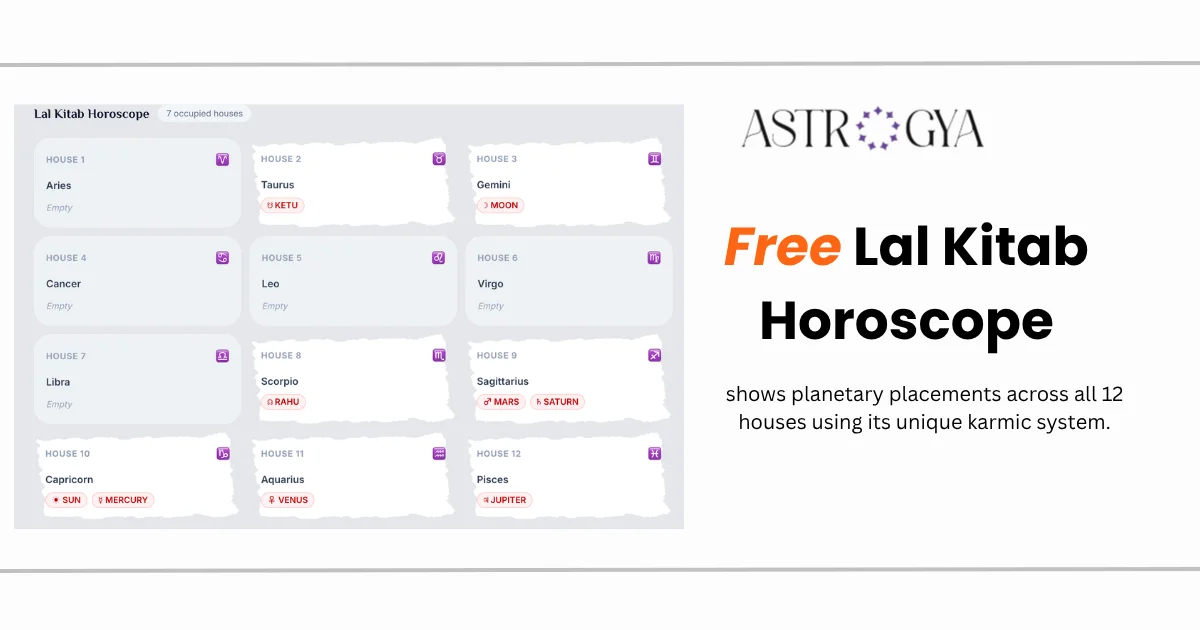
Lal Kitab is an ancient form of Vedic astrology from Punjab your horoscope shows planetary placements across all 12 houses using its unique karmic system.
Lal Kitab
Lal Kitab is a distinct system of astrology that looks at planetary influence in a very down‑to‑earth, results‑oriented way. Instead of getting lost in theory, it asks a simple question: what is actually happening in your life, and how can you correct it through conscious action?
In practice, Lal Kitab works alongside classical Indian astrology, but its focus is different: it pays more attention to houses, behavior, and karmic patterns than to complex calculations.
Many people turn to Lal Kitab when they feel stuck in one area of life career, finances, relationships, or health even after trying other remedies or systems.
The system reads planetary behavior through clear rules and house placements, then suggests simple actions that can be woven into daily routine.
Its straightforward nature is a big reason it remains popular with people who want practical guidance instead of abstract concepts.
This kind of grounded, experience‑based approach tends to build more trust with modern seekers who look for real‑life, applicable advice.
What Is Lal Kitab Astrology?
Lal Kitab astrology is a branch of predictive astrology that interprets results mainly through house placement and karmic cause‑and‑effect. In readings, I often use it as a diagnostic tool when patterns repeat and nothing else quite explains why.
01
The primary focus is on how planets behave in specific houses, rather than on sign lordships, nakshatras, or detailed divisional charts.
02
Each planetary placement is viewed as a reflection of past actions, unfinished responsibilities, or neglected duties that echo into the present.
03
Lal Kitab helps explain why certain problems keep returning, even when the timing looks favorable in traditional astrology.
04
It also shines light on why earlier remedies may not have worked, especially when they didn’t address behavior or discipline.
05
The system points toward corrective discipline clear, practical steps to gradually restore balance rather than promise sudden miracles.
Origin and Philosophy of Lal Kitab
Lal Kitab originated in North India and became known through a series of texts collectively called the “Lal Kitab.” Unlike classical Sanskrit treatises, these texts were written in simpler language so that ordinary people could actually use them.
- The core philosophy is that planetary difficulties are not random; they’re seen as outcomes of previous actions or inherited karmic patterns.
- Planets are not permanently benefic or malefic in this system they respond to how responsibly we live and how we handle our duties.
- A planet can behave kindly when our conduct aligns with its nature, and harshly when our behavior goes against its role.
- Because of this, Lal Kitab places more importance on conduct, restraint, and consistency than on ritual complexity.
- Remedies and interpretations are meant to encourage ethical living, personal accountability, and steady correction over time.
How Lal Kitab Differs From Vedic Astrology
Lal Kitab and Vedic astrology use the same planets, but they speak slightly different languages when it comes to interpretation. In my experience, they complement each other beautifully when used together.
- Vedic astrology leans heavily on sign lordship, divisional charts, nakshatras, and precise mathematical techniques.
- Lal Kitab gives primary importance to house‑based outcomes, sometimes regardless of traditional sign strength.
- The same planet can give very different results in Lal Kitab depending on which house it occupies even if it looks strong by sign in Vedic terms.
Vedic astrology is often used for life mapping, spiritual insight, and timing (dashas and transits), while Lal Kitab tends to be more problem‑solving and corrective.
In real‑world practice, many astrologers use Lal Kitab as an additional layer over the birth chart, not as a replacement for classical analysis.
Why Lal Kitab Is Known for Simple Remedies
Lal Kitab is famous for remedies that are simple, symbolic, and closely tied to daily life. Clients often appreciate how “doable” these measures feel compared to elaborate rituals.
- Remedies are not meant to overpower planetary influence but to gently restore balance through conscious, repeated actions.
- Many Lal Kitab measures involve very practical guidelines what to avoid, what to donate, how to behave, and for how long.
- The focus is on correcting misuse or neglect of responsibility instead of blindly trying to strengthen planets.
- Because they are woven into daily routine, these remedies are easier to sustain over time.
In my experience, they work best when followed with clarity and consistency, without pressure for instant results.
Free Lal Kitab Reports on Astrogya
On this page, you have access to a set of free Lal Kitab reports that let you explore this system directly through your own chart. Think of them as a guided introduction that turns theory into something you can actually see and apply.
Each free report focuses on a specific core area of Lal Kitab practice horoscope structure, debts, remedies, houses, or planets.
The tools are designed to be clear, focused, and easy to follow, even if you’re new to astrology.
You can use these free reports to spot patterns, understand where imbalance may sit, and see what kind of corrective direction is suggested.
Together, they create a solid starting point before you move into deeper, more detailed astrological analysis.
You can explore all of this at no cost, which is ideal if you’re testing whether Lal Kitab resonates with your lived experience.
Lal Kitab Horoscope (Free)
The free Lal Kitab Horoscope report introduces your chart through the Lal Kitab lens, rather than through conventional zodiac signs alone. It helps you see how this system reads your horoscope differently.
- The report presents sign numbers, sign names, and their associated planets as interpreted in Lal Kitab.
- It shows how planetary influence is assigned and which planets are more active in your chart structure.
- You get a clear sense of the framework Lal Kitab uses before diving into debts or remedies.
- This is best treated as an orientation map a starting point that explains the layout of your Lal Kitab kundli.
- Once you’ve seen this free overview, it becomes easier to understand the more detailed Lal Kitab reports that follow.
Lal Kitab Debts Report (Free)
The free Lal Kitab Debts report focuses on karmic obligations, known as rin, that may show up as repeating challenges. I often use this when clients say, “Why does this keep happening to me?”
- The report highlights the type of karmic debt indicated in your chart.
- It shows how that debt is reflected through planetary house placements.
- You’ll see which areas of life are more likely to carry recurring themes if left unaddressed.
- The tone is not fatalistic; it points to awareness and disciplined correction instead of fixed outcomes.
- Treated well, this free report becomes a mirror for patterns you might already sense but haven’t fully named yet.
Lal Kitab Remedies Report (Free)
The free Remedies report translates your Lal Kitab placements into planet‑specific corrective measures. It’s especially useful when you want to move from “understanding” to “what can I actually do?”.
- The report identifies which planet is involved and through which house it is operating.
- It summarizes traditional Lal Kitab descriptions of that placement in simple, clear language.
- Suggested remedies may include behavioral discipline, lifestyle adjustments, symbolic actions, or short‑term restrictions.
- These measures are presented as guidance, not guarantees, and they work best when followed steadily and sincerely.
- Because this report is free, you can experiment with the remedies and see how small changes begin to shift your experience.
Lal Kitab Houses Report (Free)
The free Lal Kitab Houses report explains how all twelve houses function within this system. Understanding houses is absolutely essential before you interpret any planet.
- It lists the ruling planet of each house in Lal Kitab terms.
- You’ll see which planets are generally considered favorable or unfavorable in specific houses.
- The report notes exalted and debilitated planetary influences as they are adapted in Lal Kitab practice.
- It also describes whether a house is considered active or sleeping, which changes how quickly results appear.
- With this free guide, you can start reading your own chart with more context about what each house is actually asking of you.
Lal Kitab Planets Report (Free)
The Lal Kitab Planets report focuses on how individual planets behave inside this system, and this version is also available as a free tool. It helps explain why a “strong” planet on paper might act very differently in real life.
- The report outlines each planet’s nature how it tends to behave, benefic or challenging, within Lal Kitab’s view.
- You’ll see how its placement within a sign and house might modify that basic tendency.
- It clarifies when a planet is likely to act more favorably, and when it may create strain or imbalance.
- This is especially helpful when you’re comparing your Lal Kitab reading with other systems that describe the same planet.
- Over time, you’ll notice which planets need more conscious handling, rather than just more “strengthening.”
How Lal Kitab Works
Lal Kitab operates on a clear, almost straightforward principle: planets give results mainly through the houses they occupy and the karmic responsibility attached to those houses. In synastry and individual charts alike, I see this show up as very concrete life stories.
- The system cares less about intricate calculations and more about observable outcomes tied to specific houses.
- Planetary placement is read as a reflection of behavior, discipline, and unresolved obligations.
- The entire framework is rule‑based and experiential, shaped by how patterns actually manifest in real lives.
- Its focus is corrective: it explains why a problem exists and what kind of action can help restore balance.
- Awareness and steady effort are central; without them, even the best placements can feel underused.
Planet-Based House System in Lal Kitab
In Lal Kitab, houses hold more weight than signs when it comes to interpreting results. I often start a reading by scanning house occupancy before I even think about sign dignity.
- A planet’s behavior can change dramatically depending on which house it occupies.
- Even a traditionally positive planet may create friction when its nature clashes with the house’s responsibility.
- Likewise, a planet seen as difficult in other systems can become a constructive force when placed in a supportive house.
- This is why house placement, not sign reputation, is the first step in Lal Kitab interpretation.
- Planetary strength is considered, but always in the context of house responsibility and lived outcomes.
Concept of Friendly and Enemy Houses
Lal Kitab classifies certain houses as friendly or enemy zones for each planet. This idea helps explain why some efforts feel smooth while others constantly hit invisible walls.
- A planet in a friendly house tends to express its qualities more naturally and smoothly.
- In an enemy house, the same planet may produce imbalance, resistance, or a sense that results are always “just out of reach.”
- For example, a planet connected with discipline placed in a house of comfort or indulgence can create tension.
- That tension may show up as delays, dissatisfaction, or effort without proportionate reward rather than direct loss.
- Understanding these house relationships reveals why some life areas feel harder than they logically should.
Role of Karma and Past-Life Actions
Karma sits at the heart of Lal Kitab interpretation. Planetary challenges are seen more as unfinished responsibilities than as punishment.
- A recurring financial issue might point to patterns of mismanagement, over‑reliance, or neglect that echo from the past.
- Family disharmony can reflect ancestral habits or unresolved duties that one person now carries.
- Lal Kitab suggests that such patterns are not permanent; they signal where conscious correction is needed.
- Remedies focus on behavior and discipline sustained over time, rather than on one‑time appeasement.
- When clients commit to these corrections, the same planetary combinations begin to tell a very different life story.
Lal Kitab Horoscope Explained
A Lal Kitab horoscope is not read like a standard zodiac‑heavy chart. Its strength lies in how planets function through house responsibility rather than how dignified they look by sign alone.
- A chart that appears very strong in classical terms may still create delay, inconsistency, or frustration in real life.
- Lal Kitab reframes these outcomes by asking how planetary energy is being used or misused in each house.
- It introduces themes of obligation, misuse of power, and neglected karmic roles into the reading.
- For astrologers already comfortable with birth charts, Lal Kitab acts as a corrective overlay.
- This approach helps explain why two people with similar placements can live out such different experiences.
Lal Kitab Sign Numbers and Sign Meanings
Lal Kitab often refers to signs by number rather than by symbolic names and images. This keeps interpretation clean and focused on structure rather than mythology.
- Each sign‑number has a functional role within the system, but it does not dominate the reading.
- Sign lordship and exaltation, while not ignored, take a secondary position to house behavior.
- The emphasis on numbers reduces personal bias or emotional attachment to certain signs.
- Two charts with identical sign placements can still behave very differently once house dynamics are analyzed.
- This is why Lal Kitab readers lean heavily on house interactions rather than sign symbolism alone.
Planet Association With Signs
Planet–sign associations are recognized in Lal Kitab, but they aren’t treated as rigid markers of strength or weakness. A planet “in its own sign” is not automatically a blessing.
- A planet’s natural tendencies are always weighed against the house it occupies.
- The question becomes: does this planet’s nature support or contradict the house’s responsibility?
- If the planet is asked to perform a role it doesn’t handle well, it can create friction even in a friendly sign.
- Conversely, a so‑called uncomfortable sign may still work if the house context supports the planet’s job.
- This layered approach resolves contradictions that classical interpretations sometimes struggle with.
How to Read a Lal Kitab Kundli
Reading a Lal Kitab kundli follows a specific, house‑first order. When I teach students, this is the sequence I insist on.
- Start with houses: note which houses are active, strained, or relatively calm.
- Then study planets: observe how each planet behaves in its assigned house.
- Next, assess nature: is the planet acting constructively, disruptively, or inconsistently in that area?
- Finally, look for karmic signals: repetition, delays, or repeated imbalance point toward deeper obligations.
- If obstacles keep appearing in one life area, Lal Kitab asks where responsibility is being avoided, misused, or misunderstood rather than blaming timing alone.
Lal Kitab Debts (Rin) and Their Meaning
In Lal Kitab, debts rin are very practical indicators of unfinished responsibility, not vague karmic ideas. I often see them play out as “same story, different setting” in a person’s life.
- An active debt tends to recreate similar situations, even when external circumstances change.
- Effort may feel disproportionate to results, especially in the area linked to that debt.
- These debts are signals, not life sentences, pointing toward where correction is needed.
- Lal Kitab encourages awareness and disciplined action rather than guilt or resignation.
- When addressed, the quality of experiences in that life area gradually shifts.
What Are Lal Kitab Debts?
A Lal Kitab debt represents an obligation that has not yet been fulfilled or balanced. It may arise from past actions, inherited patterns, or long‑standing neglect.
- Debts are mapped through planetary placements and house interactions in the kundli.
- Repeated financial instability, despite hard work, can indicate a financial rin that needs correction.
- Recurring relationship breakdowns with similar themes often point toward emotional or relational debts.
- Lal Kitab is less interested in blame and more focused on identifying where responsibility has been side‑stepped.
- Once identified, the aim is to restore balance through conscious, consistent behavior.
Types of Karmic Debts in Lal Kitab
Lal Kitab recognizes several broad forms of debt, each shaping life in a distinct way. In real‑world charts, they frequently overlap.
- Financial debts can appear as unstable income, sudden loss, or reliance on others even after sincere efforts at independence.
- Family or ancestral debts may show up as strained family ties, lack of support, or carrying heavy responsibility alone.
- Relationship debts can manifest as repeated emotional imbalance, trust issues, or partnerships that start strong but end in disappointment.
- Professional debts often look like stalled growth, authority conflicts, or hard work that goes unrecognized.
- These debts usually arise from how multiple planets interact with certain houses, not from a single placement in isolation.
Effects of Unresolved Lal Kitab Debts
When a debt remains unaddressed, life tends to circle back to the same lesson. The scenery changes, but the feeling is strangely familiar.
- A person might switch jobs repeatedly, only to face the same type of conflict or blockage each time.
- Someone else might move cities or change partners, yet meet the same emotional pattern in different faces.
- Lal Kitab reads this repetition as a sign that deep correction has not yet occurred.
- Addressing the debt doesn’t always require dramatic changes; often, small, disciplined shifts make the biggest difference.
- With time, consistent corrective action can soften the intensity and frequency of these recurring patterns.
Lal Kitab Remedies (Core Strength of Lal Kitab)
Lal Kitab remedies are the heart of this system. They are not designed to overpower fate, but to slowly realign your behavior with your chart’s responsibilities.
- Remedies focus on restoring balance between planetary influence and personal conduct.
- They typically involve small, practical actions repeated over a meaningful period of time.
- This makes Lal Kitab especially approachable for people who feel overwhelmed by ritual‑heavy practices.
- The remedies are corrective rather than controlling they encourage growth, responsibility, and awareness.
- In charts I’ve read, the most powerful shifts often come from the simplest, most consistently applied measures.
Why Lal Kitab Remedies Are Considered Powerful
Lal Kitab remedies are considered powerful precisely because they are simple enough to follow. Most clients can realistically maintain them.
- Instead of prescribing complex rituals, Lal Kitab often suggests changes in attitude, discipline, and routine.
- For recurring professional setbacks, for example, the focus may be on respect for authority, time discipline, or fair use of resources.
- Over time, these subtle corrections change how planetary energy is expressed in daily life.
- Remedies work best when followed without desperation more as a steady practice than an emergency fix.
- The emphasis stays on correction and alignment, not on trying to “force” specific outcomes.
Types of Lal Kitab Remedies
Most Lal Kitab remedies fall into a few clear, practical categories. I usually explain them in everyday language so people can apply them easily.
- Behavioral remedies: adjusting how you interact with elders, juniors, authority figures, or dependents.
- Lifestyle remedies: bringing discipline into food habits, daily routine, sleep, or work patterns.
- Symbolic remedies: donating or avoiding certain everyday items linked with particular planets or houses.
- Restrictive remedies: consciously limiting certain actions or indulgences for a set period.
- Every remedy category is chosen to reflect and correct the life area where imbalance is showing up.
Planet-Based Lal Kitab Remedies
Planet‑based remedies focus on the way a specific planet is expressing itself through your behavior and choices.
- When a communication planet is disturbed, remedies might involve speaking less harshly, avoiding gossip, or practicing honesty in small matters.
- If a planet linked to expansion is causing problems, corrective measures may include moderation in spending, eating, or making big promises.
- Rather than blindly strengthening a planet with gemstones or rituals, Lal Kitab aims to neutralize excess or misuse first.
- This keeps remedies grounded in real‑life behavior instead of only in external objects.
- Over time, the planet’s influence becomes more balanced and less disruptive.
House-Based Lal Kitab Remedies
House‑based remedies address the specific area of life where problems are most visible. Which is exactly where things change.
- When financial houses are under strain, remedies may involve careful handling of money, avoiding new debts, or supporting dependents responsibly.
- In relationship houses, focus may shift to healthier expectations, clearer boundaries, and reducing emotional dependency.
- Sometimes the remedy is as simple as fulfilling a long‑avoided duty connected to a particular house.
- Correcting the behavior of the house often produces more stable results than focusing on the planet alone.
- In many charts, house‑based remedies are the real turning point for long‑standing issues.
Lal Kitab Houses
In Lal Kitab astrology, houses represent areas of responsibility more than just areas of experience. A planet’s results depend heavily on how that responsibility is handled.
- Planets do not act in isolation; they respond to the condition and usage of the house they occupy.
- When responsibilities tied to a house are honored, results tend to be more stable and manageable.
- If those duties are neglected or misunderstood, outcomes can feel disproportionate to the effort you're putting in.
- Lal Kitab readings often clarify why certain life themes repeat even when external choices change.
- This house‑centered approach makes outcomes easier to connect with everyday behavior.
Lal Kitab 12 Houses Overview
Each of the twelve houses in Lal Kitab governs a clear sphere of life self, family, finances, work, relationships, social duty, and more. The key difference is how this system treats those spheres.
- Houses are seen as zones of duty, not just zones of experience or events.
- When a house functions well, related life matters tend to stay steady even under stress.
- A disturbed house may show as repeated effort with minimal or uneven results.
- Lal Kitab interpretation begins by identifying which houses are carrying strain or imbalance.
- This overview becomes the backbone for later analysis of planets and remedies.
Sleeping and Active Houses in Lal Kitab
One distinctive idea in Lal Kitab is the concept of sleeping and active houses. This explains why some areas respond quickly to effort while others barely move.
- An active house responds more quickly to effort and correction; changes show up within a reasonable time.
- A sleeping house tends to delay visible results even when sincere effort is made.
- Such delays often indicate that deeper, more consistent discipline is required.
- Recognizing which houses are sleeping prevents unnecessary frustration or jumping to the wrong conclusions.
- It also helps you set more realistic timelines for change.
Auspicious and Inauspicious Planets by House
In Lal Kitab, a planet’s nature cannot be judged in isolation it is judged in its house context. A “good” planet in the wrong house can still cause trouble.
- Some planets behave more constructively in certain houses and more disruptively in others.
- A planet inclined toward expansion may support growth in a learning or opportunity house.
- The same planet can create excess or imbalance in a house that demands restraint, focus, or boundaries.
- This house‑based view allows for nuanced readings, especially in complex charts.
- Classical reputations of planets are always filtered through house responsibility before conclusions are drawn.
Exalted and Debilitated Planets in Lal Kitab Houses
Lal Kitab treats exaltation and debilitation differently from classical sign‑based rules. The question is performance, not status.
- A planet that looks strong by sign may still create mixed or difficult results in an incompatible house.
- Likewise, a planet that seems weak by sign can perform surprisingly well in a supportive house.
- The emphasis is on how well the planet can do its job in that specific house setting.
- House compatibility often outweighs sign dignity when it comes to lived experience.
- This is why experienced Lal Kitab practitioners always re‑check house context before making judgments.
Lal Kitab Planets
In Lal Kitab astrology, planets are evaluated by how responsibly their energy is expressed through the houses they occupy. I’ve seen “difficult” planets turn into assets once their energy is handled wisely.
- Planetary behavior is seen as responsive, not fixed planets reflect how their energy is used or neglected.
- Misuse or avoidance of planetary themes tends to create imbalance or friction.
- When handled properly, even traditionally challenging planets like Saturn or Mars can act constructively.
- This perspective keeps interpretation flexible and closely tied to real life.
- It also reinforces the idea that awareness and choice can change how a chart plays out.
Nature of Planets in Lal Kitab
Lal Kitab does not freeze planetary nature in rigid categories. A planet’s role shifts with placement, aspects, and the condition of its house.
- A planet associated with authority works well when responsibility is taken up willingly and fairly.
- The same planet can feel oppressive when authority is resisted, misused, or feared.
- Lal Kitab looks at planetary behavior as a reaction to ongoing patterns of conduct.
- The more aligned your actions are with a planet’s higher expression, the smoother its results tend to be.
- This gives you room to grow beyond “good” and “bad” labels.
Benefic vs Malefic Planets
In Lal Kitab, “benefic” and “malefic” are situational labels. The same planet can support you in one area and strain you in another.
- The key question is whether the planet is placed where it can fulfill its responsibility properly.
- Lal Kitab also asks whether its energy is expressed in a balanced, conscious way.
- Overuse, suppression, or misunderstanding of a planet’s themes can all distort results.
- Strengthening a planet without understanding its house context can sometimes intensify problems.
- A more nuanced approach is to balance, guide, and correct planetary energy instead of blindly boosting it.
Planet Placement and Its Effects
Planetary placement in Lal Kitab directly shapes how results manifest in everyday life, and sometimes it’s surprisingly literal.
- A planet in a supportive house often produces steady, predictable outcomes.
- In a conflicting house, results may arrive late, in waves, or with disproportionate effort.
- For example, a discipline‑oriented planet in a house that needs flexibility can create rigidity or burnout.
- Lal Kitab interprets this as a mismatch between planetary tendency and house requirement.
- Remedies in such cases focus on adjusting behavior so the planet and house can “work together” better.
How Planets Give Results Through Houses
In Lal Kitab, planets act through houses they don’t act in a vacuum. The house is the stage; the planet is the actor.
- If a house is functioning well, planetary results are usually manageable even when challenging.
- When a house is disturbed, any planet there tends to amplify existing imbalance.
- This is why Lal Kitab often prioritizes house correction before planet‑specific remedies.
- Understanding this flow house first, planet second is key to applying the system effectively.
- Once you grasp this, readings become more coherent and remedies more targeted, sometimes almost obvious.
Lal Kitab Kundli vs Vedic Kundli
Lal Kitab and Vedic astrology are often used together, but they serve different roles in practice. I rarely recommend replacing one with the other.
- A Vedic kundli maps life potential, timing, and deeper spiritual themes.
- A Lal Kitab kundli is often consulted when problems persist or repeat despite favorable timing.
- Lal Kitab leans heavily into diagnosis and correction rather than big‑picture prediction.
- The two systems work best as partners, not competitors.
- Many experienced astrologers cross‑check both before suggesting any serious remedies.
Structural Differences
Structurally, a Lal Kitab kundli is simpler and more direct than a typical Vedic layout, yet it goes straight to the heart of certain issues.
- Lal Kitab prioritizes house placement and planetary behavior without relying on multiple divisional charts.
- Timing tools like dashas and detailed transit analysis are not its central focus.
- Vedic charts, by contrast, often require layering many techniques to reach a conclusion.
- Lal Kitab bypasses some of that complexity to highlight immediate cause‑and‑effect patterns.
- This makes it especially useful as a diagnostic layer over the main birth chart.
Interpretation Style Differences
In daily use, Lal Kitab interpretation is very problem‑centric. It zooms in on the “why” behind stubborn patterns.
- It asks: why does this issue keep repeating regardless of timing or effort?
- It looks for where responsibility is being neglected, misused, or misunderstood in the chart.
- Vedic astrology, on the other hand, often frames things around when events are likely to occur and what they signify.
- Lal Kitab narrows the focus to correction what needs to change in behavior or attitude.
- This difference is why people often turn to Lal Kitab after timing‑based answers feel incomplete.
When Lal Kitab Is More Effective
Lal Kitab tends to shine in certain types of situations. I reach for it most when the story sounds like “I’ve tried everything.”
- Repeated setbacks despite astrologically favorable periods.
- Chronic financial or professional instability that doesn’t match effort or skill.
- Persistent relationship or family issues that replay similar themes in different forms.
- Remedies from other systems that have been tried but didn’t hold or didn’t feel sustainable.
In such cases, Lal Kitab helps reveal where deeper behavioral or karmic correction is needed.
Using Lal Kitab Insights With Other Astrology Reports
Lal Kitab works best when its insights are integrated with other astrological tools. It’s a strong support system, not a stand‑alone replacement.
- A full horoscope report can show life potential, strengths, and timing opportunities.
- Lal Kitab adds a layer that explains why certain potentials feel blocked or delayed.
- Using both together allows for more precise, grounded guidance.
- This combined approach also reduces dependence on timing alone, which many clients find relieving.
- On Astrogya, you can blend the free Lal Kitab reports with your other chart reports to get a fuller picture.
Lal Kitab With Birth Chart Analysis
When Lal Kitab insights are read alongside a traditional birth chart, the picture becomes richer and more practical.
- The natal chart outlines overall structure, psychological themes, and long‑term potential.
- Lal Kitab pinpoints where responsibility may be mishandled or avoided, especially in key houses.
- A chart can show strong career promise, yet Lal Kitab reveals why progress remains patchy or slow.
- Used together, they clarify both what you’re capable of and what needs correcting.
- This integration supports more tailored remedies and realistic expectations.
Lal Kitab With Life Prediction Reports
Life prediction reports mostly focus on timing when pressures ease, when doors open, when transitions arrive. Lal Kitab explains how to walk through those doors wisely.
- It helps you understand why some favorable periods feel lighter or heavier than expected.
- Difficult phases can be reframed as times for correction, restraint, or consolidation rather than panic.
- Lal Kitab often suggests when to hold back instead of rushing ahead just because timing looks good.
- This keeps you from overreacting during challenging transits or dashas.
- Bringing both views together supports steadier decision‑making over the long run.
Lal Kitab as a Support System for Remedies
Lal Kitab is especially useful as a support system when remedies from multiple sources feel overwhelming. I’ve seen it simplify cluttered remedy lists into a few focused actions.
- A life report may highlight stress in a particular area; Lal Kitab clarifies what correction that area truly needs.
- It helps prioritize remedies so you’re not doing ten things for the same issue.
- Behavioral and lifestyle‑based measures often replace or refine more complex rituals.
- This makes your overall remedy practice more sustainable and aligned with daily life.
- Over time, this focused approach tends to deliver more real, noticeable change.
Lal Kitab FAQs
Here are answers to some of the most common questions people ask about Lal Kitab in consultations.
Is Lal Kitab Astrology Accurate?
Lal Kitab can be very effective for understanding repeating patterns and behavioral imbalance. Its usefulness depends on correct interpretation and disciplined application, not on prediction alone.
Are Lal Kitab Remedies Safe?
Generally, Lal Kitab remedies are considered safe because they emphasize lifestyle discipline, symbolic gestures, and moderate corrective actions rather than extreme measures.
Can Lal Kitab Replace Vedic Astrology?
No Lal Kitab doesn’t replace Vedic astrology. It works best as a complementary system, especially for diagnosing problems and suggesting corrective guidance.
How Long Do Lal Kitab Remedies Take to Work?
Results vary from person to person. Remedies usually work gradually and depend on consistency, sincerity, and the depth of the imbalance involved.
Can Lal Kitab Be Used Without Birth Time?
Some insights can be drawn without exact birth time, but accurate house‑based analysis generally requires a reliable birth time for best results.