Live Data
Current Planetary Positions
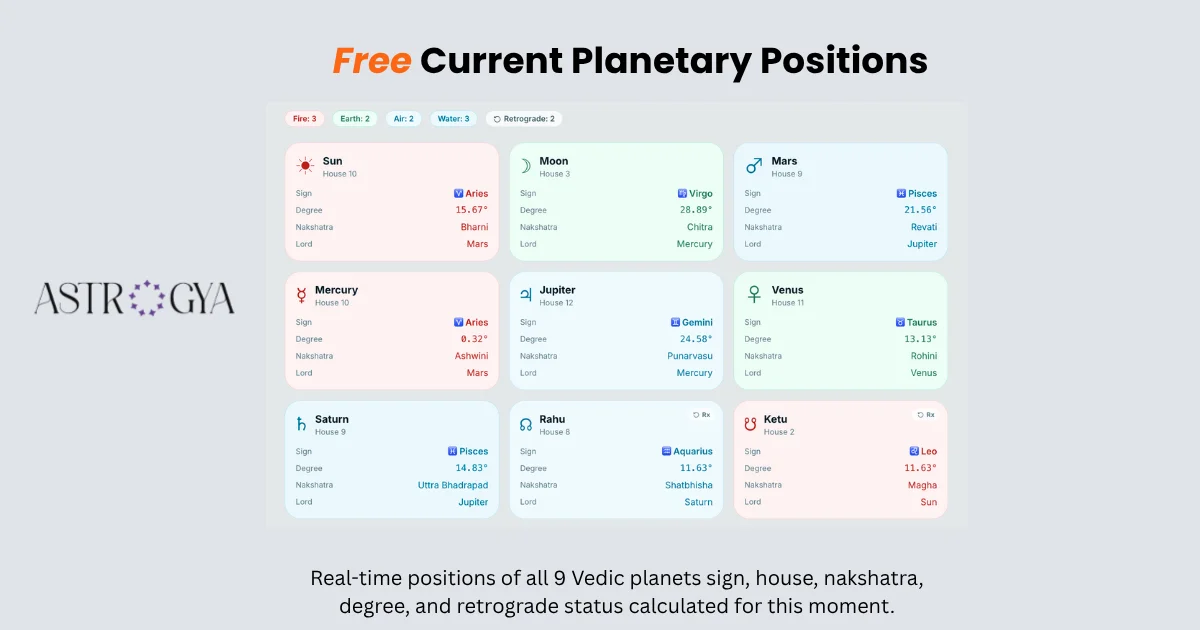
Real-time positions of all 9 Vedic planets sign, house, nakshatra, degree, and retrograde status calculated for this moment.
9 Vedic Planets Nakshatra Analysis Retrograde Status
Current planetary positions calculated for New Delhi, India
What Are Birth Chart Planetary Positions?
Planetary positions in a birth chart show the exact locations of the Sun, Moon, and planets at the moment you were born, calculated from Earth’s perspective. These positions form the basis of your natal chart and explain why astrology looks at much more than just your Sun sign.
Unlike daily horoscopes, which focus on how planets move today, birth chart planetary positions do not change. They record the sky exactly as it was at your birth and remain the same throughout your life. Each planet appears in a specific zodiac sign, house, and degree, shaping different aspects of your personality, behaviour, and life focus.
Your chart works on three levels:
-
Planets show what areas of life are active, such as identity, emotions, communication, motivation, and responsibility
-
Zodiac signs describe how those qualities are expressed
-
Houses indicate where these themes show up in daily life, like relationships, career, health, or home
Because planetary positions depend on your exact birth time and place, even small differences can change the Rising sign and house placements. This is why accurate birth details matter.
Astrologers read planetary positions together, not one by one. It’s the overall pattern of the chart that helps explain strengths, challenges, recurring themes, and long-term tendencies.
The Nine Planets (Navagrahas) in Your Chart
In Vedic astrology, planets are called "Grahas" forces that grasp or influence your life. The nine planets each govern different aspects of personality, karma, and destiny.
| Planet | Sanskrit | Governs | Strong Placement | Weak Placement |
|---|---|---|---|---|
| Sun | Surya | Soul, vitality, authority, father | Confidence, leadership, purpose | Low self-esteem, health issues |
| Moon | Chandra | Mind, emotions, mother, intuition | Emotional stability, nurturing | Mood swings, mental unrest |
| Mars | Mangal | Energy, courage, action, siblings | Ambition, decisiveness, strength | Aggression, impulsiveness |
| Mercury | Budh | Intellect, communication, learning | Sharp mind, adaptability | Confusion, nervousness |
| Jupiter | Guru | Wisdom, growth, dharma, spirituality | Prosperity, good fortune, ethics | Missed opportunities, poor judgment |
| Venus | Shukra | Love, beauty, relationships, luxury | Harmonious relationships, creativity | Relationship issues, financial problems |
| Saturn | Shani | Discipline, karma, hard work, delays | Long-term success, resilience | Obstacles, restrictions |
| Rahu | Ambition, materialism, obsession | Innovation, achievement | Confusion, addictions | |
| Ketu | Spirituality, detachment, past karma | Spiritual insight, intuition | Aimlessness, disconnection |
Benefic vs Malefic Planets
Not all planets deliver the same type of results. Vedic astrology classifies planets by their natural tendency to bring ease or challenge.
Natural Benefics (Shubha Grahas):
- Jupiter Greatest benefic brings wisdom, wealth, growth
- Venus Love, harmony, material comforts
- Moon waxing Emotional peace, nurturing
- Mercury well placed Intellect, communication skills
Natural Malefics (Papi Grahas):
- Saturn Delays, restrictions, karmic lessons
- Mars Conflict, aggression, accidents
- Rahu Obsession, confusion, sudden changes
- Ketu Detachment, losses, spiritual crisis
- Sun Ego conflicts, authority issues
Important: A malefic planet doesn't mean "bad luck." It indicates areas requiring conscious effort and growth. Placement, aspects, and house lordship determine whether any planet benefic or malefic delivers positive or challenging results in your specific chart.
Planet & Sign
Planet and sign work together to explain how different parts of your personality express themselves. The planet shows what type of energy is involved, and the zodiac sign shows how that energy comes through in everyday life.
For example, Mars in Aries tends to act quickly and directly, while Mars in Pisces approaches action in a gentler, more intuitive way. The Moon in Cancer often experiences emotions deeply, whereas the Moon in Capricorn processes feelings with more control and practicality.
Your chart shows the zodiac sign for each planet, helping you understand how motivation, emotions, thinking, and relationships are expressed in your own way.
Sign Lord (Rashi Swami)
Every zodiac sign has a ruling planet. When a planet occupies a sign, that sign's lord becomes a secondary interpretive layer.
| Sign | Lord | Sign | Lord |
|---|---|---|---|
| Aries | Mars | Libra | Venus |
| Taurus | Venus | Scorpio | Mars |
| Gemini | Mercury | Sagittarius | Jupiter |
| Cancer | Moon | Capricorn | Saturn |
| Leo | Sun | Aquarius | Saturn |
| Virgo | Mercury | Pisces | Jupiter |
Venus in Taurus occupies its own signpowerful "swakshetra" placement expressing full potential. Mars in Cancer sits in Moon's sign, introducing emotional complexity to Mars's assertive nature.
Degree (fullDegree vs normDegree)
Degrees specify exact position within the zodiac.
- fullDegree: Position across the entire 360° zodiac circle (0° Aries start). Sun at 72.19° fullDegree sits in Gemini.
- normDegree: Position within the current sign's 0-30° range. That same Sun reads as 12°11' Gemini. When astrologers say "Sun at 12 degrees Gemini," they reference normDegree.
Nakshatra & Nakshatra Lord
Beyond twelve signs, Vedic astrology divides the sky into 27 nakshatras (lunar mansions), each spanning 13°20'. Each nakshatra carries distinct qualities governed by its nakshatra lord.
Your Moon's nakshatracalled Janma Nakshatrareveals emotional wiring and determines your Vimshottari Dasha sequence (planetary period system predicting life chapters).
Nine lords cycle through 27 nakshatras: Ketu, Venus, Sun, Moon, Mars, Rahu, Jupiter, Saturn, Mercury. Moon in Ashwini nakshatra (Ketu lord) emphasizes new beginnings. Moon in Punarvasu (Jupiter lord) seeks philosophical understanding.
House Placement
Twelve houses represent life domains where planetary energies manifest. Birth time and location determine which sign occupies each house cusp.
| House | Life Domain | House | Life Domain |
|---|---|---|---|
| 1st | Self, body, personality | 7th | Marriage, partnerships |
| 2nd | Wealth, speech, family | 8th | Transformation, hidden matters |
| 3rd | Siblings, courage, communication | 9th | Fortune, higher learning, father |
| 4th | Home, mother, emotions | 10th | Career, reputation, public life |
| 5th | Children, creativity, romance | 11th | Gains, friends, aspirations |
| 6th | Health, enemies, daily work | 12th | Loss, spirituality, foreign lands |
Sun in 10th house emphasizes career and recognition. Sun in 4th house illuminates home and inner security. A planet can occupy a favorable sign but sit in a challenging housecreating nuanced interpretation.
Retrograde Status
Retrograde planets appear to move backward due to Earth's orbital relationship with them. Your results show "true" for retrograde, "false" for direct motion.
Retrograde planets internalize energy making their expressions more subjective, delayed, or subject to reassessment. A retrograde Mercury might process information differently, rather than simply having "bad communication."
Planet Awastha (Strength by Degree)
Awastha classifies planetary strength based on degree position, using age metaphors.
| Awastha | Odd Signs (°) | Even Signs (°) | Strength |
|---|---|---|---|
| Bala (Infant) | 0-6 | 24-30 | Weak |
| Kumara (Youth) | 6-12 | 18-24 | Half |
| Yuva (Adult) | 12-18 | 12-18 | Full |
| Vriddha (Aged) | 18-24 | 6-12 | Moderate |
| Mrit (Dead) | 24-30 | 0-6 | Minimal |
Venus at 16° Libra sits in Yuva (adult) awasthafull relationship harmony. Venus at 28° Libra drops to Mrit (dead) awastharequires conscious activation.
Combustion
When planets get too close to the Sun, their energy becomes overwhelmed by solar heat. Combust Venus might struggle with relationship visibility. Combust Jupiter can internalize its wisdom.
How Planetary Positions Affect Your Life
Your birth chart shows how different areas of life tend to unfold, such as health, relationships, work, finances, and personal growth. This comes from where the planets were placed at your birth and how they interact with each other.
Planetary Periods (Dashas)
Vedic astrology uses a timing system called Dashas. Each phase of life is influenced by a different planet, sometimes for months and sometimes for many years. When a planet’s period is active, its themes become more noticeable.
- A Saturn period often brings responsibility, structure, and lessons through effort.
- A Venus period usually highlights relationships, comfort, and enjoyment.
Planetary Transits
Planets are always moving in the sky. As they move, they interact with the planets in your birth chart. These movements can trigger events, changes, or opportunities. Looking at today’s planetary positions in relation to your chart shows which areas of life are currently active and where attention may be needed.
Planetary Combinations (Yogas)
Some planets form specific combinations in a chart. These patterns are called yogas and are traditionally linked with certain results. Some combinations support success or leadership, others support learning, stability, or financial growth. Yogas do not guarantee outcomes, but they describe tendencies that become stronger at certain times.
Why Birth Time Accuracy Matters
Your birth time helps determine your Rising sign and the layout of your houses, which are key parts of a birth chart. As the Earth rotates, the Rising sign changes roughly every two hours. Even a small difference in time can shift important details in your chart.
If the birth time is off, planets may appear in the wrong houses or the Rising sign itself may change. This affects how accurately areas like career, relationships, health, and timing systems are interpreted. In Vedic astrology, the Rising sign is considered just as important as the Sun and Moon, and many timing techniques depend on it.
If you are unsure of your exact birth time, start by checking your birth certificate. Hospital records can also help. Family recollections are useful as a rough guide but are usually less precise.
The more accurate the birth time, the more reliable the chart and its interpretations.
Frequently Asked Questions
Q. Can I use this without exact birth time?
Yes, but results lack house placements and Ascendant. Planetary signs, nakshatras, and degrees remain valuable. For complete accuracy, locate birth records or consider professional rectification.
Q. Why does my Sun sign differ from Western astrology?
Vedic astrology uses sidereal zodiac (actual constellations); Western uses tropical zodiac (seasons). The 24-degree difference means your Vedic Sun may shift one sign backward — tropical Aries often becomes Pisces in Vedic. Both systems work within their frameworks.
Q. Which planetary position matters most?
Moon, Sun, and Ascendant form your "Big Three." Moon governs mind/emotions, Sun represents soul/vitality, Ascendant shapes personality/life approach. Start here before exploring other positions.
Q. What if multiple planets show weak awastha?
Every chart contains strengths and weaknesses — this creates human complexity. Weak awastha means areas requiring development, not doom. Vedic astrology offers remedies (mantras, gemstones, rituals) to strengthen challenged planets.
Q. Do my planetary positions ever change?
Birth chart positions never change — they're a fixed moment. What changes are current transits moving through the sky, compared against natal positions to forecast trends.
Q. Does retrograde always mean problems?
No. Retrograde internalizes energy rather than creating malfunction. Retrograde Mercury processes deeply before speaking. Retrograde Venus indicates unique relationship values. It adds nuance, not negativity.