The Complete Guide on Mundane Astrology
The Complete Guide mundane astrology and its Planetary Influence on Nations, World Events and History
A
Astrogya Teammundane astrology
What it is: Astrology of nations, governments, and world events.
Oldest form: Babylon, c. 2000 BCE.
Vedic name: Medhini Jyotish.
Key charts: National chart, Solar Ingress, Eclipse, Lunation, Jupiter-Saturn conjunction.
Key cycles: Jupiter-Saturn 20-year cycle, Saturn-Pluto synodic cycle.
Used for: Political forecasting, war and peace cycles, economic trends, natural disaster prediction.
What is Mundane Astrology?
Mundane astrology is the branch of astrology that studies the fate of nations, governments, economies, and collective humanity through planetary cycles. It uses the same planets, houses, and aspects as personal astrology but every signification shifts from the individual to the collective.
Where natal astrology answers "what is happening to this person," mundane astrology asks "what is happening to this people."
The Meaning of "Mundane" in Astrology (Latin, Sanskrit and Vedic Origins)
The word comes from the Latin mundus, meaning "the world" not trivial or ordinary, but the earthly realm of collective existence. In Vedic tradition, the Sanskrit root is Medini, meaning "earth" as a living collective body.
Both Greek-Roman and Vedic traditions independently arrived at the same principle: celestial patterns imprint on collective human life just as surely as on individual fate.
Medhini Jyotish The Vedic Name for Mundane Astrology
Medhini Jyotish is the classical Vedic term for mundane astrology. Its foundational text is Varahamihira's Brihat Samhita (c. 550 CE), covering rain prediction, crop forecasting, earthquake omens, military outcomes, and the fates of ruling dynasties.
In ancient India, this was never separate from governance. Kings kept court astrologers specifically to read Medhini charts before declaring wars or initiating state policy.
How Mundane Astrology Differs from Natal Astrology
Mundane astrology reads collective charts for nations, lunations, ingresses, and conjunctions not for any individual. The 1st house no longer describes a person's body; it describes a nation's public health and identity. The 10th house is not someone's career it is the sitting government.
The other key difference: mundane practice never relies on a single chart. Multiple chart types are layered simultaneously to build a complete picture.
The History of Mundane Astrology From Babylon to the Modern World
Mundane astrology is the oldest documented form of astrological practice older than the personal horoscope by at least 1,500 years.
Babylonian Origins The Oldest Branch of Astrology (4000+ Years)
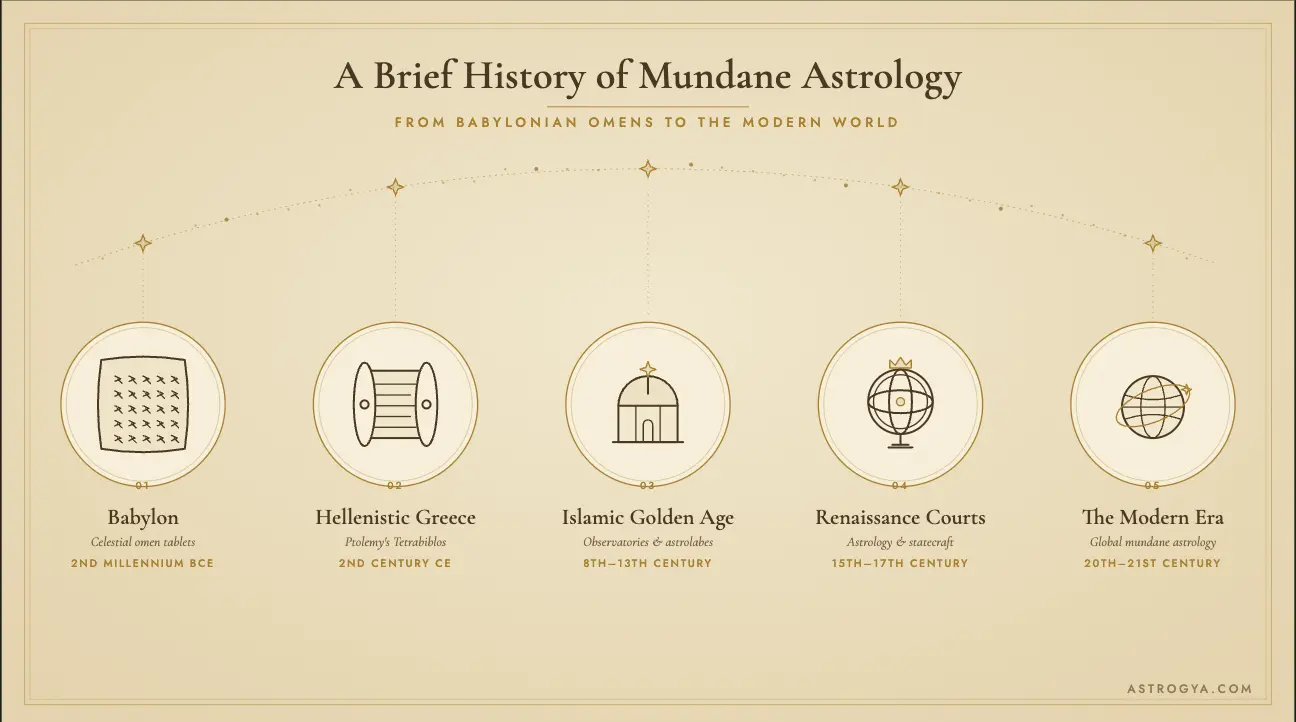
The baru priests of ancient Babylon tracked celestial omens not for individuals but for the king and kingdom. Tablets from the Neo-Assyrian period, dating to c. 2000 BCE, record planetary observations linked to floods, invasions, and plagues. Individual horoscopes did not yet exist astrology at its origin was always mundane.
Ptolemy and the Tetrabiblos The Greek Foundation
Claudius Ptolemy dedicated all of Book II of the Tetrabiblos (c. 150 CE) to mundane practice. He assigned all 73 known nations to zodiac signs and established eclipses, cardinal ingresses, and Jupiter-Saturn conjunctions as the three primary forecasting instruments. His framework remained the Western standard for over 1,400 years.
Islamic Golden Age Contributions to Mundane Techniques (9th-10th Century)
Abu Ma'shar al-Balkhi's Kitab al-Qiranat ("Book of Conjunctions") formalized the theory that Jupiter-Saturn conjunctions shifting element the Great Mutation mark civilizational turning points. These refinements entered European practice through 12th-century translations and shaped Renaissance court astrology directly.
Renaissance Courts When Kings Relied on Astrologers
From the 13th through 17th centuries, mundane astrology held official status in European governance. Guido Bonatti advised military campaigns from ingress charts. Tycho Brahe submitted state astrological reports to the Danish crown. This was not fringe practice it was institutional, embedded in how governments made decisions.
B.V. Raman and the Modern Vedic Mundane Tradition
Dr. B.V. Raman (1912-1998) is the defining figure of modern Vedic mundane astrology. Through The Astrological Magazine, he published advance predictions on World War II, India's independence, and Gandhi's assassination all in print before the events, with dates. His Hindu Predictive Astrology, Chapter 31, remains the primary practitioner reference for Medhini Jyotish today.
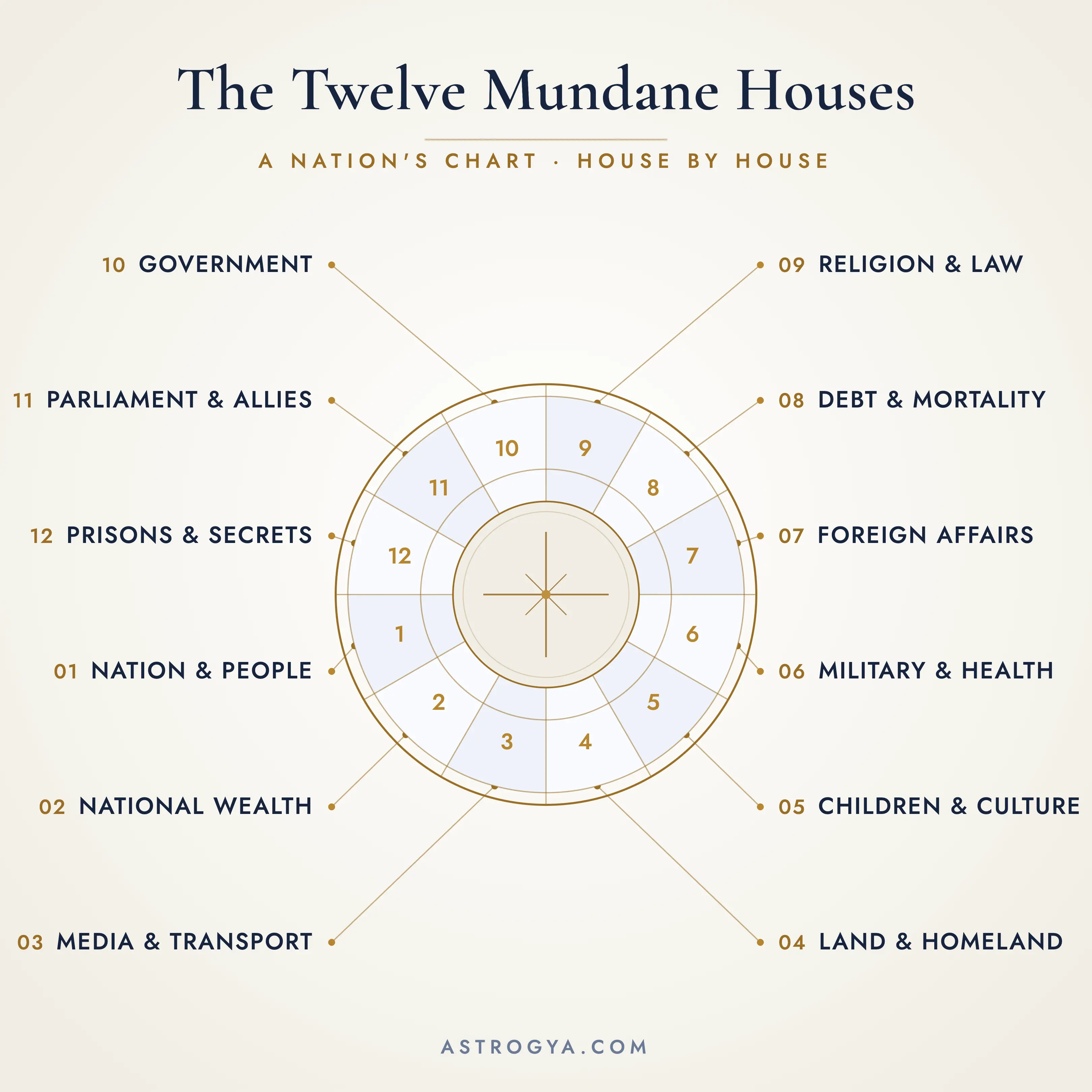
The 12 Houses in Mundane Astrology What Each House Rules for a Nation
House | National Domain | Key Themes |
|---|---|---|
1st | National identity, public health | People, general prosperity, national character |
2nd | Treasury, banking | Revenue, stock exchange, natural resources |
3rd | Communications, transport | Media, railways, neighboring countries |
4th | Land, agriculture, weather | Crops, housing, opposition parties |
5th | Birth rate, diplomacy | Children, entertainment, speculation |
6th | Military (enlisted), epidemics | Public health crises, labor, civil services |
7th | Foreign affairs, treaties | Alliances, marriage law, open enemies |
8th | National death rate, war losses | Public debt, taxation, financial crises |
9th | Religion, law, higher education | Judiciary, foreign trade, sea travel |
10th | Government, head of state | Ruling party, national reputation |
11th | Parliament, legislature | Allies, national revenues, aspirations |
12th | Secret enemies, institutions | Prisons, espionage, hidden affairs |
Planets in Mundane Astrology What Sun, Moon, Mars, Saturn and Outer Planets Represent
Sun Kings, Leaders and Government Authority
The Sun represents the head of state and the formal authority of the government. A strong, well-aspected Sun supports stable leadership. Affliction by Saturn or Rahu signals challenges to the ruler's authority or a government without public mandate.
Moon Public Sentiment, Food, Water and Women
The Moon governs collective mood, the condition of women and children, food supplies, and water resources. Monthly lunation charts are primary working tools in mundane practice precisely because the Moon is the most immediately responsive indicator of public sentiment.
Mars War, Military, Police and National Disputes
Mars rules military leadership, the police, and the combative energy of a nation. Hard aspects from Mars to Saturn or Pluto in mundane charts consistently accompany civil unrest, military action, or industrial accidents. Mars in the 1st, 7th, or 8th house of an ingress chart marks elevated conflict risk.
Jupiter and Saturn The Great Chronocrators and Political Cycles
Jupiter and Saturn are called the Great Chronocrators the timekeepers because their 20-year conjunction cycle sets the pace of political change across civilizations.
Jupiter: Judiciary, religious institutions, financial expansion, the nation's moral compass
Saturn: Administrative structures, land borders, the elderly, mining, enforced discipline
The 2020 conjunction at 0 Aquarius marked the first Great Mutation into Air in approximately 200 years, widely read as a template for institutional restructuring through the 2030s.
Rahu and Ketu Uniquely Vedic Mundane Significations
Rahu in a national chart indicates foreign influence, mass obsession, epidemic potential, and sudden disruption from outside the normal order. Ketu points to collective losses, ideological dissolution, and the erosion of structures that have outlived their purpose. The Rahu-Ketu axis always operates across two houses simultaneously both poles must be interpreted.
Outer Planets (Uranus, Neptune, Pluto) in Western Mundane Astrology
Planet | Western Mundane Signification |
|---|---|
Uranus | Revolution, technology, electoral upheaval, earthquakes |
Neptune | Ideology, mass delusion, oil markets, pandemics, currency crises |
Pluto | Hidden power structures, debt collapse, nuclear issues, regime transformation |
These planets are not used in classical Medhini Jyotish but are incorporated by modern practitioners integrating both traditions.
Types of Charts Used in Mundane Astrology
A mundane astrologer layers multiple chart types each covers a different time resolution and serves a different interpretive purpose.
National Foundation Charts The Birth Horoscope of a Country
A national foundation chart is cast for the moment a country formally came into existence: the declaration of independence, the constitutional signing, or a new government proclamation. India's Independence Chart (August 15, 1947, 00:00 IST, New Delhi) is widely validated. The USA Sibley Chart (July 4, 1776, 5:10 PM, Philadelphia) is the most used Western national chart, though its exact time remains debated.
Solar Ingress Charts The Aries, Cancer, Libra and Capricorn Ingress
A solar ingress chart is cast for the exact moment the Sun enters each cardinal sign for a specific national capital. These quarterly charts carry authority for their three-month period. The Aries Ingress is the most important, functioning as the annual chart for the coming year.
Lunar Year Horoscope Annual Prediction in Vedic Mundane Astrology
In Medhini Jyotish, the annual chart is cast for Mesha Sankranti the Sun's entry into Aries for the national capital. It is read alongside the national foundation chart's Solar Return to build the composite annual forecast. B.V. Raman placed significant weight on this chart in all his published annual predictions.
Monthly Lunation Charts Reading the New Moon for Any Nation
Each New Moon generates a lunation chart for any location. Mundane astrologers cast these monthly for national capitals to track the shifting house emphasis throughout the year. A New Moon conjunct a sensitive degree of the national chart natal Ascendant, natal Sun, or natal Saturn is treated as a trigger for events signified by that point.
Eclipse Charts Solar, Lunar and the 14-Day Rule
Eclipses rank above all other chart types in magnitude of effect. A solar eclipse activates a nation's affairs for up to six months if it falls within close orb of a sensitive national chart point. The classical Vedic rule places the onset of effects within 14 days of the eclipse in mundane matters.
Jupiter-Saturn Conjunction Charts The 20-Year Political Cycle Clock
A chart cast for the exact Jupiter-Saturn conjunction, set for a national capital, functions as a 20-year political and economic blueprint for that nation. Abu Ma'shar formalized this technique in the 9th century. The 2020 conjunction chart at 0 Aquarius is currently active as a framework for reading global institutional change through the late 2030s.
Real-World Examples When Mundane Astrology Predicted History
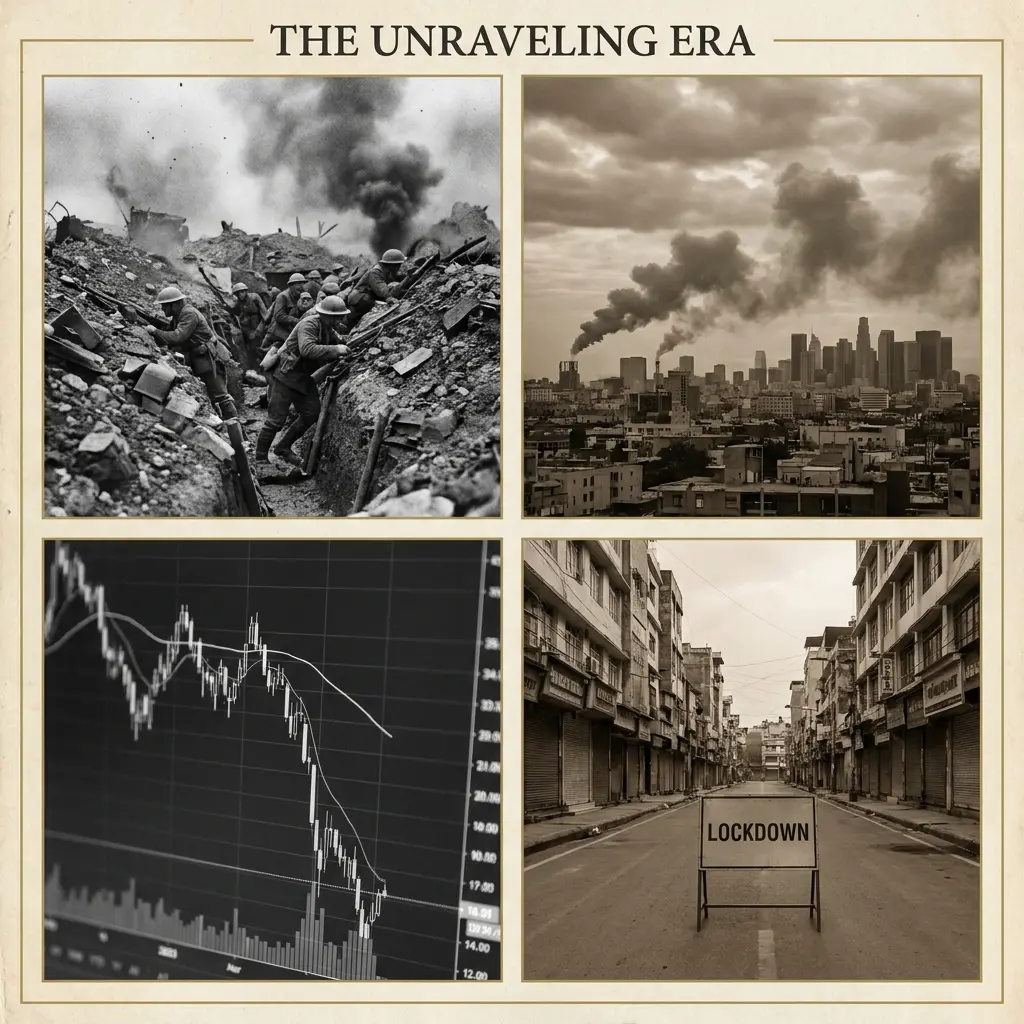
B.V. Raman's Prediction of World War II Published One Year in Advance
In 1938-1939, through The Astrological Magazine, B.V. Raman published explicit forecasts of a coming world war its timing, the likely aggressor, and the eventual Allied victory before hostilities began. This record is not oral tradition; it exists in dated, archived print issues held by ICAS Bengaluru. His subsequent verified predictions include Gandhi's assassination, the 1962 Chinese aggression against India, and the fall of multiple world leaders.
Saturn Opposing Pluto and September 11, 2001
Saturn and Pluto moved into exact opposition in August-November 2001, falling across the 1st and 7th houses of the USA Sibley Chart and activating the natal Mars-Neptune square. Several astrologers had flagged this configuration in writing before September 2001 as indicative of a severe external attack on the nation. The configuration is now a documented reference point in the Saturn-Pluto cycle literature.
Pluto Entering Capricorn and the 2008 Global Financial Crisis
Pluto entered Capricorn in January 2008 for the first time in 248 years. Capricorn rules banking institutions, corporate hierarchies, and established financial systems. The global financial crisis peaked in September-October 2008 with the collapse of Lehman Brothers. Multiple astrologers writing in 2006-2007, tracking Pluto's Capricorn ingress, published forecasts describing structural financial collapse and forced banking reform.
Jupiter-Saturn Air Conjunction 2020 and the COVID-19 Pandemic Era
The December 21, 2020 conjunction at 0 Aquarius was the first Air-sign Jupiter-Saturn conjunction in approximately 200 years a Great Mutation. It coincided with the peak of the COVID-19 pandemic and the beginning of global vaccination campaigns. The preceding Saturn-Pluto conjunction of January 2020 at 22 Capricorn, conjunct the USA's natal Pluto, had been flagged by mundane astrologers as a systemic crisis indicator well before the WHO emergency declaration.
Mundane Astrology vs Natal Astrology Key Differences Explained
Factor | Natal Astrology | Mundane Astrology |
|---|---|---|
Subject | One individual | A nation, government, or world event |
Time frame | Lifetime | Days to centuries depending on chart type |
Number of charts | One natal chart | Multiple charts layered simultaneously |
1st house | Physical body, personality | National identity, public health |
10th house | Career, public status | Sitting government, head of state |
Saturn transit | Personal discipline, delays | Austerity, regime pressure, structural change |
Primary tools | Progressions, transits | Ingress, eclipse, lunation charts |
Individual Chart vs National Chart Scale and Interpretation Differences
Every signification in a national chart is amplified by the scale of a nation and carries policy-level consequences. An astrologer who reads a national chart as if it were a personal one will consistently misread the evidence. The 2nd house is not personal finance it is the national treasury and banking system.
Why Mundane Astrology Uses Multiple Charts Simultaneously
No single chart type captures all layers of national experience. The national foundation chart reveals permanent structural character. Ingress and lunation charts overlay current planetary conditions. Eclipse charts mark moments of concentrated intensity. All three levels are required for a competent mundane reading.
The Inception Chart Problem Finding a Country's True Birth Time
The most persistent technical challenge in mundane astrology is uncertainty about the precise birth moment of modern nations. For India, the midnight chart of August 15, 1947 is widely accepted and repeatedly validated. For many post-colonial nations, the inception chart problem remains genuinely unresolved, and practitioners should acknowledge this rather than treating any national chart as definitive.
Vedic Mundane Astrology (Medhini Jyotish) vs Western Mundane Astrology A Full Comparison
Feature | Medhini Jyotish (Vedic) | Western Mundane |
|---|---|---|
Primary text | Brihat Samhita, Varahamihira (c. 550 CE) | Tetrabiblos, Ptolemy (c. 150 CE) |
Zodiac | Sidereal | Tropical |
Timing method | Vimshottari Dasha + transits | Transits, progressions |
Geographic grid | Koorma Chakra (Nakshatra-based) | Ptolemy's national sign assignments |
Outer planets | Not in classical texts; used by modern practitioners | Core to modern interpretation |
Verified tradition | B.V. Raman, Varahamihira, Jataka texts | Ptolemy, Abu Ma'shar, modern Western schools |
Brihat Samhita by Varahamihira The Classical Vedic Sourcebook
The Brihat Samhita is the encyclopedic practitioner's reference for Medhini Jyotish. Unlike the Tetrabiblos, which is primarily theoretical, the Brihat Samhita is organized by phenomenon: rain prediction, earthquake omens, military portents, and the Koorma Chakra geographic grid. It provides outcome tables and case examples that practitioners apply directly.
Sidereal vs Tropical Zodiac in Mundane Predictions
Vedic practice uses the sidereal zodiac, producing a roughly 23-degree difference from the tropical zodiac. Pluto entering "Capricorn" in 2008 by tropical reckoning was still in Sagittarius sidereally a different interpretive context. Both traditions have produced verified predictions; the zodiac question does not invalidate either, but comparing across traditions requires noting which framework is in use.
Dasha System vs Transit Cycles How Timing Differs Between Traditions
Western mundane astrology times events primarily through real-time transits over national chart points. Vedic practice adds the Vimshottari Dasha a 120-year sequence of planetary periods that activates different national chart significations in turn. The Dasha provides a long-range timing structure that transit-only analysis cannot replicate. India running a Mars-Rahu period during 1962 adds timing specificity that no Western transit method alone would generate.
Countries and Zodiac Rulers Ptolemy's Map vs Vedic Koorma Chakra
Ptolemy's system: 73 nations assigned to zodiac signs in Tetrabiblos Book II, Chapter 3 based on perceived national character and Greek geographic knowledge
Koorma Chakra: 27 nakshatras mapped onto nine directional zones the eight compass directions plus center used to locate the geographic direction of predicted events
The two systems are structurally different: Ptolemy assigns national identity by sign; Koorma Chakra predicts event location by direction
What the Reddit Astrology Community is Actually Asking About Mundane Astrology
The National Chart Reliability Debate Sibley Chart vs Ingress Chart
"The question ultimately becomes 'which charts are reliable?' in these cases. For nation-states, where there are sufficient and specific historical events that could be used to confirm a chart, there seems to be more consistency." r/Advancedastrology, January 2026
Where genuine historical uncertainty exists about a national chart, ingress and lunation charts should serve as the primary working tools. The national foundation chart then functions as contextual background rather than a definitive anchor. The Sibley Chart is the best-tested USA chart in print, but its exact Ascendant degree is still debated by serious practitioners.
Can Mundane Astrology Be Separated from Confirmation Bias?
"I think [mundane astrology] is rife with confirmation bias and that focusing on history, game theory and macroeconomics would be more productive." r/Advancedastrology, January 2026
This is a legitimate challenge. Retrospective interpretation starting with the event and working backward to find planetary justification is not evidence. The only form of mundane astrology that provides genuine evidence is the model B.V. Raman used: publish the prediction in advance, with a named mechanism and a specific time window, and let the dated record stand.
The Koorma Chakra The Ancient Vedic Geography Grid for Mundane Predictions
The Koorma Chakra is the most uniquely Vedic technique in mundane astrology and the least accessible in English-language content. What follows is the clearest structured explanation currently available online.
What is the Koorma Chakra? The Tortoise Map of the World
The Koorma Chakra (literally "tortoise diagram") is a geographic prediction grid that assigns each of the 27 nakshatras to one of nine directional zones the eight compass directions plus a central region. The shape mirrors a tortoise viewed from above. Its practical purpose is to answer what no zodiac sign assignment can: in which geographic direction will this planetary event manifest?
How Varahamihira Used Koorma Chakra in Brihat Samhita
Varahamihira described the Koorma Chakra in the Brihat Samhita as a method for locating the geographic direction of malefic or benefic planetary effects. The operational method: identify which nakshatra a malefic planet (particularly Saturn) currently occupies, locate that nakshatra's directional sector on the grid, and the corresponding region becomes the focus of predicted difficulty.
Direction | Nakshatras | Regional Reference (India-centric) |
|---|---|---|
Central | Krittika, Rohini, Mrigashira | Central India |
East | Ardra, Punarvasu, Pushya | Bihar, Bengal, Northeast |
South-East | Ashlesha, Magha, Purva Phalguni | Andhra, Vidarbha |
South | Uttara Phalguni, Hasta, Chitra | Tamil Nadu, Kerala, Sri Lanka |
South-West | Swati, Vishakha, Anuradha | Goa, SW Maharashtra |
West | Jyeshtha, Moola, Purvashadha | Gujarat, Baluchistan |
North-West | Uttarashadha, Sravana, Dhanishtha | Kashmir, Pakistan, Afghanistan |
North | Shatabhisha, Purva Bhadra, Uttara Bhadra | Tibet, Himachal Pradesh, Central Asia |
North-East | Revati, Ashwini, Bharani | Nepal, Bhutan, Arunachal Pradesh |
Applying Koorma Chakra to Predict Natural Disasters and Earthquakes
The operational rule: place all transiting planets in their current nakshatras on the Koorma grid. The directional sector receiving the highest concentration of malefics Saturn, Mars, Rahu, and eclipses within orb is the zone at elevated risk for earthquake, flood, military conflict, or epidemic. When luminaries conjoin Rahu in South-East nakshatras, the Brihat Samhita specifically flags earthquake and tsunami risk in the countries of that direction.
Koorma Chakra vs Western Astrocartography Two Geographic Prediction Systems
Feature | Koorma Chakra (Vedic) | Astrocartography (Western) |
|---|---|---|
Developed | Varahamihira, c. 550 CE | Jim Lewis, 1976 CE |
Method | Nakshatra-to-direction mapping on fixed grid | Planetary lines projected on world map via angular houses |
Primary use | Collective events: earthquakes, wars, crop failures | Personal relocation; secondarily, national event location |
Geographic output | Directional zones | Precise longitude lines worldwide |
The Collective Psychological Shadow in Mundane Astrology A New Framework
This section presents a synthesis not currently found in the indexed mundane astrology literature: applying Carl Jung's psychology of the collective unconscious as an interpretive lens for outer planet transits in national charts. Know planet rep
What Carl Jung Said About Astrology and Collective Consciousness
Jung wrote directly about astrology in his correspondence and in essays collected in C.G. Jung Letters and The Structure and Dynamics of the Psyche. His stated position: "Astrology is one of the intuitive methods... based upon the synchronicity principle, meaningful coincidence." For Jung, planets did not cause events they were synchronistic markers appearing in meaningful correlation with collective psychological states.
His concept of the collective unconscious the layer of psyche shared across a culture maps naturally onto the outer planets in mundane charts.
Pluto Transits as Civilizational Shadow Work When Nations Face Their Darkness
Pluto transits in a national chart function as timed encounters with the civilizational shadow the accumulated, unacknowledged material of a society's history. Pluto's passage through Capricorn (2008-2024) forced to the surface the hidden corruption in banking systems, the unspoken agreements between capital and government, and the concealed costs of economic growth. The 2008 financial crisis was not merely economic it was the forced emergence of material that the collective had been suppressing for decades.
Pluto does not permit avoidance. The transit ends only when the shadow material has been acknowledged and integrated.
Neptune in National Charts Mass Delusion, Ideology and the Fog of War
Neptune's transit over a national chart's sensitive points introduces collective idealization, mass narrative, and the dissolution of previously clear boundaries. Neptune transiting the national 1st house is associated with epidemics of unclear origin, collective disorientation, and mass ideological movements that operate through emotional resonance rather than rational argument. The decade following any Neptune transit through Capricorn consistently reveals the structural consequences of the idealization that preceded it.
Saturn as the Collective Superego Authority, Repression and Civilizational Limits
Saturn in Jungian terms is the collective superego the internalized social law and enforced discipline of civilization. Saturn transiting the 1st, 4th, or 10th house of a national chart tightens the superego: austerity policies, surveillance expansion, and authoritarian governance tend to emerge. Every Saturnine repression generates an equal and opposite Plutonian eruption later societies that suppress economic inequality under Saturn transits tend to see it explode under subsequent Pluto aspects.
A Practical Framework for Reading the Jungian Shadow in Any National Chart
Three questions to ask for any national chart under major outer planet pressure:
What is being suppressed? Identify which house and natal planets are under Pluto's current influence. Those significations represent what the collective is refusing to acknowledge.
What narrative is replacing reality? Neptune's current house position reveals the dominant ideological or emotional frame through which the society is misreading its own situation.
What structural limits are being enforced? Saturn's transit position shows which domains of national life are under pressure to conform, contract, and comply.
Reading all three simultaneously gives mundane forecasting a psychological depth that purely event-based prediction cannot provide.
Conclusion:
Mundane astrology reveals how planetary cycles shape nations and world events, but your own birth chart sits inside that same cosmic story. Astrogya (astrogya.com) gives you free Vedic tools including birth charts, planetary transits, and Dasha timelines so you can see exactly where global cycles like Saturn-Pluto or Jupiter-Saturn intersect with your personal life. For deeper, chart-specific answers, GYAN (astrogya.com/gyan) reads your horoscope in context of current mundane transits and explains in plain language what the collective shifts mean for your career, relationships, and timing.