Top 6 AI Astrology Systems in the World in 2026
A
Astrogya TeamGYAN
We tested the systems people actually use and with the real astrologers, checked pricing on the source pages, and labelled honestly what is real conversational AI, what is automation dressed up as AI, and what is written entirely by humans.
Here are the six that matter in 2026, ranked and compared.
What Is an AI Astrology System, and How Is It Different From a Horoscope App?
An AI astrology system reads your actual birth chart and answers your questions about it, rather than serving the same Sun-sign horoscope to everyone born in a four-week window. The difference is personalisation depth. A horoscope app broadcasts; an AI astrology system responds to your placements.
The strongest systems combine three things:
Accurate chart calculation from your date, time, and place of birth
An interpretation layer that reads your specific planets, houses, and aspects
A conversation or memory function that lets you go deeper over time
Not everything marketed as AI clears that bar. Some apps run pre-written templates. Others still rely on real astrologers behind the screen. We flag which is which for every entry below.
If you want to see your own placements first, our free birth chart calculator generates a full Western natal wheel before you compare tools.
How We Tested and Ranked These 6 AI Astrology Systems
We scored each system on six criteria, weighted toward how the product performs for a real user over weeks, not minutes.
Criterion | What we checked |
|---|---|
AI type | True conversational AI, templated automation, or human-written |
Astrology system | Western foundation, house system, Sun vs Rising basis |
Personalisation depth | Does it read your chart or just your Sun sign |
Memory | Does it remember your chart and past conversations |
Pricing transparency | Clear flat pricing vs per-minute or surprise billing |
Privacy | How your chart and conversation data are handled |
Pricing figures were taken from each product's own store or help pages in mid-2026. Astrology app pricing shifts often, so re-check before you subscribe.
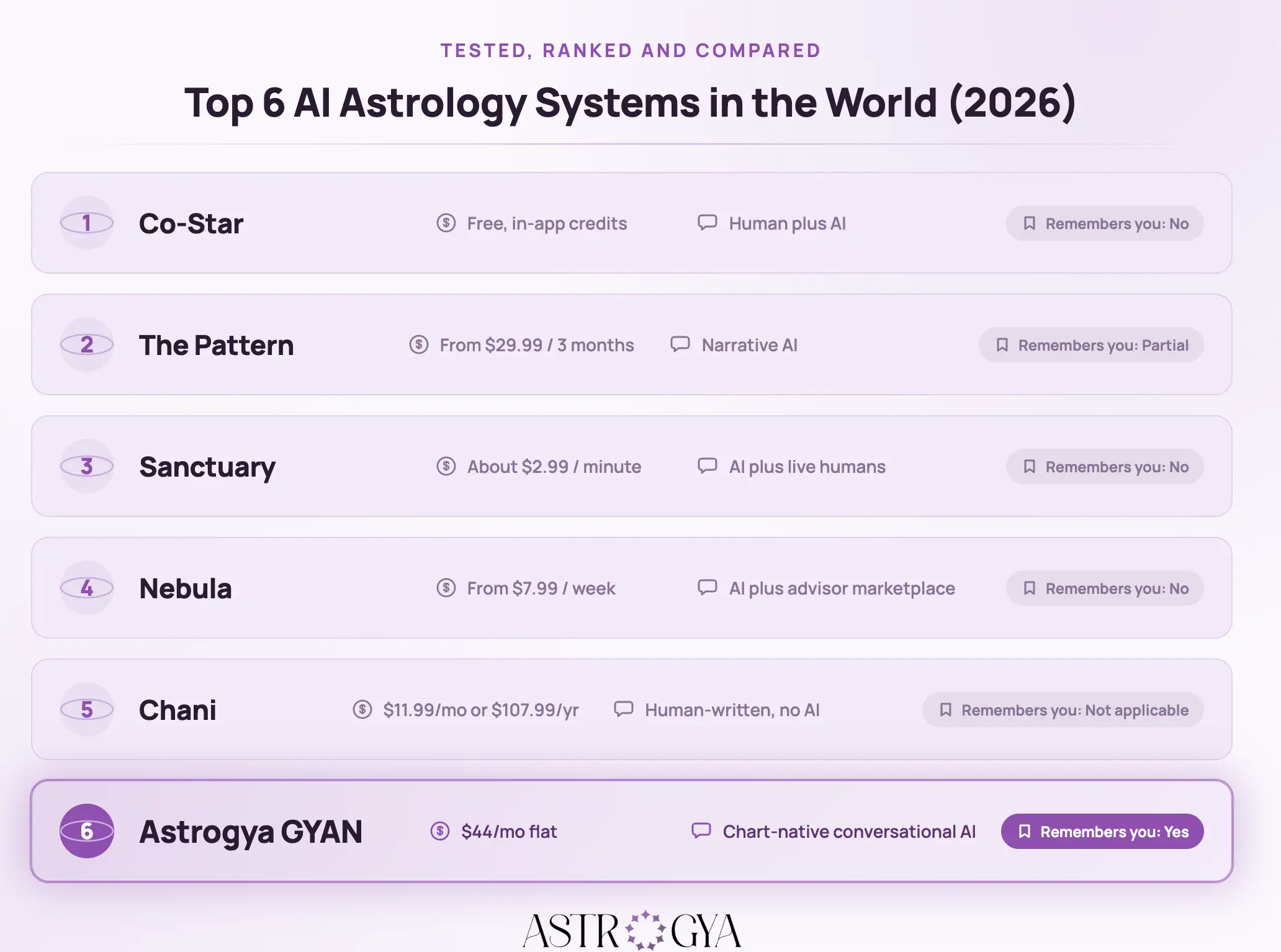
AI Astrology Systems Compared at a Glance (Price, AI Type, System, Best For)
Rank | System | Price | AI type | Persistent memory | Best for |
|---|---|---|---|---|---|
1 | Co-Star | Free app, a la carte question credits (about $7) | Human astrologers plus AI, automated notifications | No | Social and compatibility |
2 | The Pattern | Free, Go Deeper+ from $29.99 / 3 months | Narrative AI feature ("In-Depth") | Partial | Psychological self-discovery |
3 | Sanctuary | Free daily, readings about $2.99/min, Sanctuary+ about $19.99/mo | AI text plus live human astrologers | No | Live human readings on demand |
4 | Nebula | $7.99/wk, $24.99/mo, or $29.99 / 3 months, advisors about $3.99/min | AI horoscopes plus psychic marketplace | No | All-in-one hub |
5 | Chani | Free tier, $11.99/mo or $107.99/yr | None, 100 percent human-written | Not applicable | Human-written depth |
6 | Astrogya GYAN | $44/mo flat | Chart-native conversational AI | Yes, chart and last conversation | Ongoing conversational guidance |
1. Co-Star: The Social AI Astrology System That Started It All
What It Is and Who It Is Best For
Co-Star is the app that made astrology social, and it is best for people who want blunt daily prompts and easy compatibility comparisons with friends. It defined the category and still owns the culture, even if it no longer leads downloads.
Pricing and Free Tier
Free to download on a freemium model. Per its own FAQ, all revenue comes from a la carte in-app purchases; its AI feature, the Void, sells question credits, and one reviewer reported paying about $7 for credits.
Key Features and How the AI Actually Works
Uses NASA and JPL data interpreted by human astrologers who collaborate with AI
The Void answers a question once and does not carry the thread forward
Punchy push notifications are the signature experience
Pros and Cons
Pros: strong social and compatibility layer, recognisable, free to start
Cons: the Void does not remember you, notifications can feel harsh, credits add up
2. The Pattern: AI Astrology for Psychological Self-Discovery
What It Is and Who It Is Best For
The Pattern turns your chart into plain-language psychological insight, and it is best for people who want self-understanding without astrology jargon. It leans into emotional patterns and timing.
Pricing and Free Tier
Free to use with an auto-renewing Go Deeper+ subscription starting at $29.99 for three months, per its App Store listing.
Key Features and How the AI Actually Works
Its conversation feature is called In-Depth
Delivers narrative insights about behaviour and relationship dynamics
Includes Connect, an astrology-based dating feature
Pros and Cons
Pros: readable, emotionally resonant, good for reflection
Cons: less chart-technical, subscription framing is aggressive, limited memory across sessions
3. Sanctuary: AI Readings Plus Live Human Astrologers
What It Is and Who It Is Best For
Sanctuary pairs quick AI text with the option of a live human astrologer, and it is best for people who want a real reading on demand. The New York Times described it as an "Uber for astrological readings."
Pricing and Free Tier
Free daily horoscopes. Live readings run about $2.99 per minute, with a common intro deal of $4.99 for five minutes, and a Sanctuary+ subscription around $19.99 per month.
Key Features and How the AI Actually Works
AI handles daily horoscopes and light chat
Live per-minute readings connect you to an actual astrologer, not a bot
Sanctuary+ unlocks an Explore library plus a short reading
Pros and Cons
Pros: genuine human readings, credible backing, flexible
Cons: per-minute cost can climb fast, the AI layer is light, no persistent memory
4. Nebula: The All-in-One AI Astrology and Psychic Hub
What It Is and Who It Is Best For
Nebula bundles horoscopes, compatibility, tarot, and a large advisor marketplace, and it is best for people who want everything in one place. Its App Store listing claims a community of over 12 million.
Pricing and Free Tier
An auto-renewing weekly subscription at $7.99 with a three-day trial, a monthly at $24.99, and a three-month at $29.99. Live advisor readings run about $3.99 per minute after the first three free minutes.
Key Features and How the AI Actually Works
AI horoscopes and compatibility across a broad feature set
A marketplace described as more than 1,000 spiritual advisors
Mixes automated content with paid human advisor chat
Pros and Cons
Pros: broad feature range, large advisor pool, low entry price
Cons: billing is a repeated complaint, with users reporting charges they say they never approved; no persistent chart memory
5. Chani: The Human-Written Benchmark (and Why It Is Not Really AI)
What It Is and Who It Is Best For
Chani is the strongest human-written app in this set, and it is best for people who want editorial depth from named astrologers. We include it as a benchmark, but it is important to be clear: Chani is not an AI astrology system.
Pricing and Free Tier
Free to download with a meaningful free tier, then $11.99 per month or $107.99 per year, a 25 percent annual saving, per Chani's own help pages.
Key Features and How the AI Actually Works
Organises content by Rising sign rather than Sun sign
Uses whole-sign houses, a traditional Western approach
Its landing page states plainly that content is written by astrologers, not AI
Pros and Cons
Pros: highest editorial credibility, founded by a bestselling astrologer, strong free tier
Cons: not conversational, does not answer chart-specific questions live, no AI at all
6. Astrogya GYAN: Building World's Best AI Astrology System
What It Is and Who It Is Best For
Astrogya's GYAN is a chart-native conversational AI that remembers your birth chart and your last conversation, and it is best for people who want an ongoing astrological dialogue rather than one-off answers. It reads your placements and picks up where you left off.
Pricing and Free Tier
One flat rate of $44 per month. No per-minute meter, no question credits, and no advisor upsell.
Key Features and How the AI Actually Works
Persistent chart memory: keeps your natal chart and placements across sessions
Zero conversation storage by design: it remembers your chart, not the text of your chats
Chart-native answers that read your specific planets and houses, not Sun-sign generalities
Pros and Cons
Pros: remembers you, transparent flat pricing, privacy by design, true conversational AI
Cons: higher headline price than freemium apps, single-product focus rather than a marketplace
Ready to try a system that actually remembers your chart? Explore Astrogya's GYAN and start a conversation that continues.
The Memory Test: Which AI Astrology Systems Actually Remember You Between Sessions?
Most AI astrology tools forget you the moment you close the app, which breaks the illusion of a relationship with your chart. We scored each system on whether it carries your chart and conversation forward.
System | Remembers your chart | Remembers your conversation |
|---|---|---|
Co-Star | Stores your chart | No, the Void answers once |
The Pattern | Stores your chart | Partial |
Sanctuary | Stores your chart | No |
Nebula | Stores your chart | No |
Chani | Stores your chart | Not applicable, no chat |
Astrogya's GYAN | Yes | Yes, last conversation |
Only one system in this set is built around continuity. That is the axis to watch as AI astrology matures.
The AI Astrology Trust Score: A 5-Signal Framework
We built a simple five-signal score to cut through self-serving rankings. A system earns one point per signal it satisfies.
Named astrologer or clear human authorship
Data privacy you can actually verify
Pricing transparency with no per-minute or surprise billing
Chart-native answers rather than Sun-sign templates
Stated source methodology for its calculations
System | Trust signals met (of 5) | Weakest signal |
|---|---|---|
Co-Star | 3 | Pricing clarity on credits |
The Pattern | 3 | Chart-native depth |
Sanctuary | 3 | Per-minute pricing |
Nebula | 2 | Pricing transparency |
Chani | 4 | Not conversational AI |
Astrogya's GYAN | 4 | Single-product breadth |